
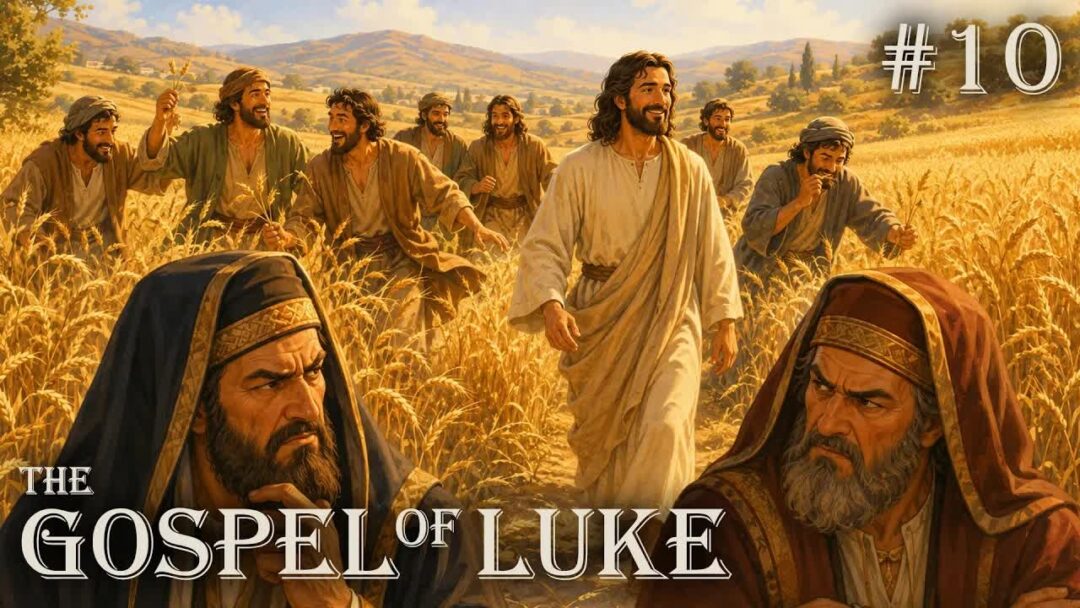
From our Sunday service on August 2, 2026, Luke 6:1-11, with the parallel accounts in Matthew 12 and Mark 2-3. This is part 10 of our Gospel of Luke series. Watch the full message: The Lord of the Sabbath – The Gospel of Luke #10 on YouTube.
Doing what pleases God will not always bring the approval of people who claim to speak for Him. Jesus meets that kind of opposition in these Sabbath conflicts. His disciples are hungry, a man needs healing, and the religious leaders see opportunities to accuse rather than needs to meet. Jesus will not let their interpretation of God’s law turn mercy into wrongdoing. I want us to see both parts of His example, because God wants you to be like Him even when others say it is wrong to do so.
A Law Given to Help
The first dispute begins in a grainfield. The disciples pluck grain, rub it in their hands, and eat it as they travel. Certain Pharisees accuse them of doing what is unlawful on the Sabbath. Their objection is not that the disciples are stealing. The law of Moses permitted a traveler to pluck grain by hand from a neighbor’s field. The hungry traveler mattered, and the law allowed him to eat.
The accusation instead rests on what counts as work. God’s command gives His people rest from their labor, even during harvest. But these critics treat the picking of a little grain as though it were harvesting the field. They have made their interpretation as binding as the command itself. That changes a law intended to refresh body, mind, and spirit into an instrument that keeps hungry people from eating. Jesus does not begin by accepting their terms. He directs them back to Scripture and asks them to compare what they say with what God has already recorded:
And he said unto them, Have ye never read what David did, when he had need, and was an hungred, he, and they that were with him? How he went into the house of God in the days of Abiathar the high priest, and did eat the shewbread, which is not lawful to eat but for the priests, and gave also to them which were with him? And he said unto them, The sabbath was made for man, and not man for the sabbath:
Mark 2:25–27
David’s need brings the purpose of the law into view. He and his men need food, and the priest has no ordinary bread to give them. The bread available is sacred, set aside for the priests, yet the priest gives it to the hungry men. Jesus places that account before people who claim to know the Scriptures. They cannot interpret one instruction as though everything else God has said about human need no longer matters. The law was given to benefit people, not to make their suffering the price of rigid religious appearances.
That is the force of His statement that the Sabbath was made for man. God did not create people merely to keep a system of regulations going. He gave His instructions for their good. In David’s case, preserving life mattered more than preserving the ordinary restriction on who could eat that bread.
Mercy and the Authority of Christ
Jesus adds another comparison His critics cannot dismiss without difficulty. The priests continue their service in the temple on the Sabbath. If the command meant that every kind of activity was forbidden without distinction, the very priests serving God would be guilty. Their accepted temple service shows that the critics’ absolute interpretation does not work. Jesus then takes the discussion beyond their authority to decide what His disciples may do:
Or have ye not read in the law, how that on the sabbath days the priests in the temple profane the sabbath, and are blameless? But I say unto you, That in this place is one greater than the temple. But if ye had known what this meaneth, I will have mercy, and not sacrifice, ye would not have condemned the guiltless. For the Son of man is Lord even of the sabbath day.
Matthew 12:5–8
One greater than the temple is present. Jesus is not a teacher trying to secure an exemption from the religious authorities; He is Lord even of the Sabbath. His critics have become so occupied with regulations that they have forgotten mercy, love for their neighbor, and care for their community. That failure has led them to condemn people who are guiltless. God is still God regardless of their interpretation.
This principle requires discernment, not blind obedience to whichever rule someone places before us. Preserving human life takes priority over demands that would destroy it. We recognize that when an oppressive government orders people to surrender innocent lives to death. Obedience to government does not make participation in that destruction right. The image of God in a human being is more valuable than compliance with a murderous authority. The point is not that God’s instruction harms us and must be discarded. It is that we must understand His instruction rather than use one command to defeat the purpose He has made clear elsewhere.
A Person Worth More Than Property
The next conflict makes the issue impossible to hide. On another Sabbath Jesus teaches in a synagogue where a man has a withered right hand. The scribes and Pharisees watch to see whether He will heal. They are looking for an accusation against Him. Jesus knows what they are thinking, but He does not leave the man hidden while He negotiates with His critics. He calls him to stand in the midst and asks whether the Sabbath permits doing good or doing evil, saving life or destroying it.
The question exposes their priorities. Jesus knows they would rescue a sheep from a pit on the Sabbath. They are willing to act when property and its value are at stake. Why should concern for a suffering person receive less consideration? Jesus makes them face the worth of the human being they are prepared to leave unaided:
And he said unto them, What man shall there be among you, that shall have one sheep, and if it fall into a pit on the sabbath day, will he not lay hold on it, and lift it out? How much then is a man better than a sheep? Wherefore it is lawful to do well on the sabbath days.
Matthew 12:11–12
We ought not look at that contradiction as though it belongs only to people long ago. Our society also treats other people’s needs as somebody else’s problem while guarding property and financial security as the highest priorities. I see the same reasoning in the claim that the financial burden of having a child justifies killing the baby. If our philosophy makes property valuable and human life expendable, we are on the wrong side. Jesus challenges that order of values, and telling the truth about it will still make people uncomfortable. Their discomfort does not make His teaching wrong.
And when he had looked round about on them with anger, being grieved for the hardness of their hearts, he saith unto the man, Stretch forth thine hand. And he stretched it out: and his hand was restored whole as the other. And the Pharisees went forth, and straightway took counsel with the Herodians against him, how they might destroy him.
Mark 3:5–6
Jesus is angry and grieved at their hardness, and He heals the man. Their response is not repentance or joy over his restoration. They begin planning to destroy the one who has restored him. They even join with the Herodians, people on the opposite side of their political divisions, because hostility to Jesus supplies a common cause. That is how far a heart can go when it refuses correction. Rather than admit that a person matters more than their rules and property, these opponents turn a demonstration of mercy into a reason to plot murder.
Faithful Without Seeking a Fight
Jesus does not surrender His ministry when that danger grows. He withdraws and continues elsewhere, and great crowds come to Him. People are still healed, restored, and taught. The critics have opposed the healing of one man, and Jesus goes on helping multitudes. Withdrawal is not the same as agreeing that His opponents are right. It allows Him to keep doing the work instead of letting their anger determine the direction of His ministry.
He also silences the unclean spirits that announce who He is. His ministry is not to become an escalating public confrontation before its time. Matthew explains His conduct by pointing to the promised character of God’s servant. Jesus will fulfill His mission without becoming the violent figure His opponents’ hostility might seem to demand:
Behold my servant, whom I have chosen; my beloved, in whom my soul is well pleased: I will put my spirit upon him, and he shall shew judgment to the Gentiles. He shall not strive, nor cry; neither shall any man hear his voice in the streets. A bruised reed shall he not break, and smoking flax shall he not quench, till he send forth judgment unto victory. And in his name shall the Gentiles trust.
Matthew 12:18–21
The gentleness in that prophecy does not mean Jesus has no truth to speak. We have just watched Him expose hypocrisy and insist on the value of human life. But He does not answer opposition by starting a revolution or forcing people into submission. When His hour comes, He will go as a sacrifice rather than fight His way free. His purpose governs both His courage and His restraint. He will not stop obeying the Father to please His critics, and He will not abandon the Father’s way merely because His critics are eager for a fight.
We need that same combination. Speak the truth in love, not through violence, force, and oppression. Know God’s Word well enough to recognize what He values, and do not let religious appearances take the place of mercy. There will be people convinced they are right who criticize or condemn the very obedience God requires. Our responsibility is not to satisfy them at the expense of His will. It is to choose love over empty appearances, people over man-made restrictions, and obedience over approval. God wants you to be like Him even when others say it is wrong. Will you devote yourself to being like Christ today?
Recent Comments