
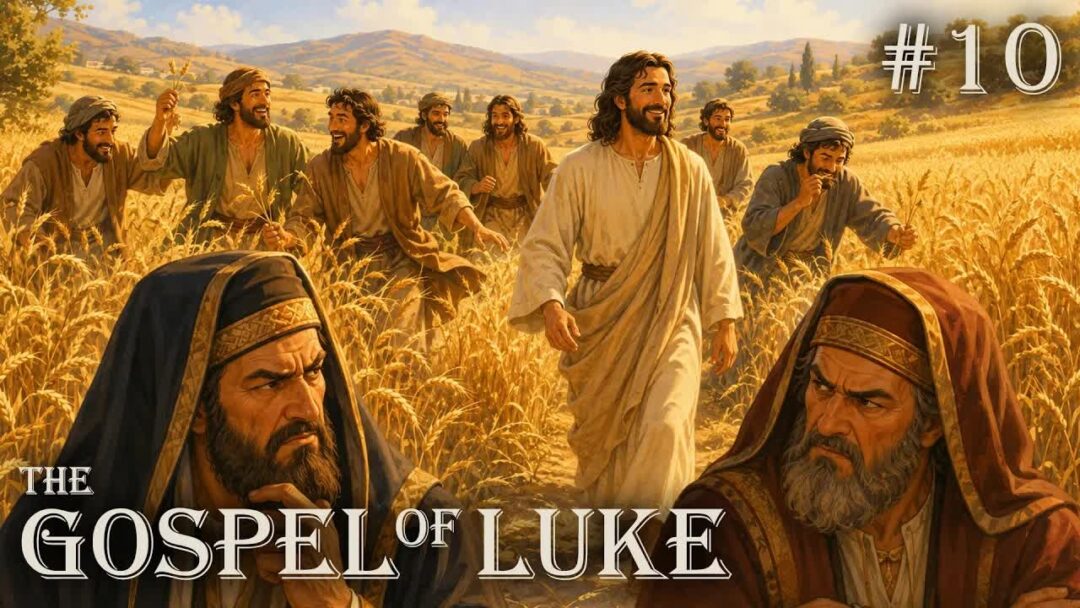
From our Sunday service on August 2, 2026, Luke 6:1-11, with the parallel accounts in Matthew 12 and Mark 2-3. This is part 10 of our Gospel of Luke series. Watch the full message: The Lord of the Sabbath – The Gospel of Luke #10 on YouTube.
This message is a little different. Luke’s account has less information about this series of events than all the Gospels combined, so instead of looking only at Luke, we’ll hop around between the Gospels to cover all the details of the story.
Last time, Jesus taught, did miracles, and called Matthew to be his disciple, and at the end of that lesson we saw Jesus confronted by the religious leaders for telling and showing them that he had the authority to forgive sins. The confrontation with the Pharisees, the scribes, and the teachers of the law is not going to be any different here. We continue through the narrative as Jesus is confronted by the religious leaders for all the ways he goes about serving others.
God wants you to be like him even when others say it is wrong to do so.
Plucking Grain on the Sabbath
We start in Luke 6, continuing exactly where we left off. Jesus is going to get into multiple conflicts, and here is the first.
And it came to pass on the second sabbath after the first, that he went through the corn fields; and his disciples plucked the ears of corn, and did eat, rubbing them in their hands. And certain of the Pharisees said unto them, Why do ye that which is not lawful to do on the sabbath days?
Luke 6:1–2
The Pharisees accuse Jesus’ disciples of committing a sin by plucking ears of grain on the Sabbath. Our King James says corn. That is the old English word for corn, not modern corn. Corn on the cob, as we call it today, wasn’t discovered until America was discovered. The old English word means any grain. This was probably wheat or barley. You might think, “Plucking raw barley and wheat out of the field doesn’t sound like a very good snack.” It’s not. What’s going on is that his disciples have been traveling. Jesus has been preaching city to city to city, and they’re hungry. They haven’t had a lot of food because they’re always traveling. So they plucked ears of grain and ate them. The Pharisees see this and say, “Why are you doing what is not lawful? Why are you breaking the law of Moses, the law of the land of Israel? Why do you commit sin?”
You may be tempted to think the sin is stealing food that doesn’t belong to them. That’s not what’s going on. The law of Moses actually permitted them to take food as they traveled.
When thou comest into the standing corn of thy neighbour, then thou mayest pluck the ears with thine hand…
Deuteronomy 23:25
The law of Moses said it was completely legal to go through your neighbor’s field and pluck some grain for a snack. That might seem foreign to us as Americans. We think, “It’s my property. It’s mine. Get your own food.” But the law of Moses didn’t see it that way. If a traveler went through your field and you had a tree that grew fruit, or you had grain, he could in all justification take whatever he could hold in his hands. Why? In Israel it was dangerous to travel. There was no easy way to refrigerate food or keep it from spoiling. You can’t put food in your car and drive all the way where you’re going. You have to carry everything with you. So, to aid in travel, it was legal to take food from fields. If you needed a snack on your travel, you could walk over to the grove with fruit on the vine and take whatever you could fit in your hands. It was illegal to take a big old basket, load it up, and leave. The idea was not to get free food, but to sustain you on your travels.
Their Interpretation
So the Pharisees aren’t calling out the disciples for stealing from this field. They’re calling them out for something else. The Pharisees are accusing them of breaking the law of Exodus 34:21, which says, “Six days thou shalt work, but on the seventh day thou shalt rest: in earing time and in harvest thou shalt rest.” What’s happening is that the disciples are moving to the next town over on the Sabbath day, on Saturday, the day on which the law of Moses says no work should be done.
If you’re familiar with the Pharisees and the religious leaders of the day, you probably know they had 613 laws built upon the law of Moses that dictated how and what you could do. Of these, 5 dealt with the Sabbath (2 commands for what to do and 3 commands for what not to do). Eventually, it ballooned into 39 categories of things not to do on the Sabbath. One of those laws took an interpretation of this verse and made it more strict than the verse says. The verse says that on the seventh day you shall rest. On the Sabbath you are not to do, quote unquote, work. So the question became what counts as work and what does not. This verse specifically says that in earing time and in harvest you can’t work. So the religious leaders said, “It says harvest, so we will interpret it that any time you pick even one single grain off your plant, that’s harvesting, and it counts as work.” Under the 613 laws, they made it so you could not take even a single grain off your plant on Saturday.
The religious leaders took this interpretation and said, “This is our law, and it’s equal to what the Bible says.” The Bible doesn’t say it like that. What it’s telling you is not to harvest your field on the Sabbath day. It’s not saying you can’t pick a single grain on the Sabbath. But they took their tradition and began to teach their interpretation as being as valid as the original law. Jesus’ disciples are following the Deuteronomy command that you may pluck the ears with your hand, but the Pharisees say, “No, no. It is Saturday. Why do you allow your disciples to sin?”
The Pharisees extended the law beyond what it was intended for. What was this law intended for? To make you rest, to make sure you’re not working seven days a week. If you’re working seven days a week, it’s not healthy. “Six days thou shalt work, but on the seventh day thou shalt rest.” It’s a time to get alone with God and refresh your body, mind, and spirit for the week ahead. That law was made to help us. The Pharisees turned it into something to harm us.
Have Ye Never Read?
And he said unto them, Have ye never read what David did, when he had need, and was an hungred, he, and they that were with him? How he went into the house of God in the days of Abiathar the high priest, and did eat the shewbread, which is not lawful to eat but for the priests, and gave also to them which were with him? And he said unto them, The sabbath was made for man, and not man for the sabbath:
Mark 2:25–27
Jesus confronts the Pharisees not by arguing about what they currently interpreted. He didn’t go straight to them and say, “You interpreted that scripture wrong.” Instead, he wants to outmaneuver the Pharisees before he goes in for the kill, so to speak. “Haven’t you read the scriptures?” This is a blatant insult. If you go to a pastor and say, “Haven’t you read the Bible?” you are insulting them. That is an intentional insult. So Jesus says to the Pharisees, “Have you not read the scriptures? Didn’t you study the account of David? Haven’t you compared the word of God with the word of God?” Because when you do, you would understand that your interpretation doesn’t make any sense. If Jesus had confronted them first with “That’s not what this means,” the Pharisees would have attacked him: “You don’t believe in the literal words of God. You believe in metaphors. You’re not a literalist.” Jesus was outsmarting them by going to this first. He asked them about the short story in 1 Samuel 21.
Then came David to Nob to Ahimelech the priest: and Ahimelech was afraid at the meeting of David, and said unto him, Why art thou alone, and no man with thee? And David said unto Ahimelech the priest, The king hath commanded me a business, and hath said unto me, Let no man know any thing of the business whereabout I send thee, and what I have commanded thee: and I have appointed my servants to such and such a place. Now therefore what is under thine hand? give me five loaves of bread in mine hand, or what there is present. And the priest answered David, and said, There is no common bread under mine hand, but there is hallowed bread; if the young men have kept themselves at least from women. And David answered the priest, and said unto him, Of a truth women have been kept from us about these three days, since I came out, and the vessels of the young men are holy, and the bread is in a manner common, yea, though it were sanctified this day in the vessel. So the priest gave him hallowed bread: for there was no bread there but the shewbread, that was taken from before the LORD, to put hot bread in the day when it was taken away.
1 Samuel 21:1–6
Ahimelech was afraid at the meeting of David because David was being pursued by Saul. Saul wanted him dead, because David had been anointed the next king of Israel. In this passage, David and his soldiers are fleeing from Saul. They are on the run, and they’ve run out of food. Effectively, David and his men are starving. If they go back to the areas that know they’re wanted, they’re not going to get any food. They’ll be arrested and put in prison, and David will be killed. This is a desperate situation, exactly the kind of situation that original command about taking the heads of grain was made for, to make sure nobody starves to death.
So David goes to the priest at Nob, at the house of God, and says, “Do you have any food?” This was normal, because the Levitical priests would divide a certain percentage of the tithes to feed the poor and hungry. Unfortunately, when David arrives, they’ve already run out of food for the poor and hungry. There’s nothing left. But the law of Moses also designated a portion of the food for the priests, to make sure they always had food and that the priest didn’t have to decide whether to put food on the table for the hungry in his community or feed himself. God in his wisdom said, “I’m not going to make my priests make that decision.” So there was separate food for the community and food for the minister. When David gets there, the food for the community is all gone. There’s not a piece of bread left, not a head of grain in the storehouse. But there is food left for the minister, and the law of Moses says that food only goes to the minister. Here the priest makes the decision: “You’re starving, and if you don’t get food you’re going to die. So I will give you from the food that is sacred and set aside for the priests, so that you do not die of starvation.”
What Jesus is saying is, “You don’t interpret the grain-picking law right. It’s there to say that your personal property isn’t more important than somebody else’s life. If you understood that law, you would understand what happened with David and why he was allowed to take the sacred bread.” That rule kept the minister from having to decide between feeding the community and feeding himself. If that law weren’t in place, that place would have been out of food on both sides, and there wouldn’t have been enough for the starving David, and he would have died. But when they saw David and his men starving to death, they knew that the rule designating that food for the priest wasn’t as important as keeping David and his men alive. Rules are there to help us, not to harm us. The law of Moses is not made to harm you. It’s made to sustain you.
Jesus makes this very clear: “The sabbath was made for man, and not man for the sabbath.” The law of God was made to benefit man. Man was not made just to follow the law. The law is a tool to help mankind make the right decisions. Its rules are not meant to chain us to a rigid, oppressive lifestyle. The book of the Torah is instructions and teachings, not just rules and regulations to oppress us.
One Greater Than the Temple
To bring the point home, Jesus gives them a second example.
Or have ye not read in the law, how that on the sabbath days the priests in the temple profane the sabbath, and are blameless? But I say unto you, That in this place is one greater than the temple. But if ye had known what this meaneth, I will have mercy, and not sacrifice, ye would not have condemned the guiltless. For the Son of man is Lord even of the sabbath day.
Matthew 12:5–8
After challenging them by comparing scripture with scripture and cornering them on this issue, then and only then does Jesus come in for the kill on the interpretation they originally accused him with. By their fully literal interpretation of not working on the Sabbath, there should be no work at all. But that can’t be the intended interpretation. Why? What do the priests do on the Sabbath? They continue to do sacrifices for God. If it meant no work at all, then every priest who ever served God has broken the law, because they still have to make a sacrifice on the Sabbath day. “I don’t think you want to stick to your interpretation, Pharisee. Your interpretation makes every priest a sinner, and therefore disqualified to make sacrifices, because he profanes the Sabbath day by doing work, even though he does it for God.”
“In this place is one greater than the temple.” He’s talking about himself, Jesus Christ. If the priests have the right to serve in the temple, then Jesus Christ, who is going to usher in the new church, the new body of Christ, the new temple, has more authority over this issue than you think. Then he says, in effect, “If you had known the scripture that says, ‘I desired mercy, and not sacrifice,’ you’d understand what this is about.” By the time that was written, the people had made the rules and regulations the entire religion. They began to neglect the parts of the religion that were to love your neighbor, love your community, put others above yourself, and have kindness and mercy and not judgment. The rules had become such a strong part that they’d completely forgotten what the law was about. “For the Son of man is Lord even of the sabbath day.” In other words, God is still God regardless of your interpretation.
Preserving Life
What is he really saying? That preserving life is the most important thing. These Pharisees were more than happy to let a man starve to death on Saturday just to keep their rules, and they would have felt fully justified in doing so. If a starving man had an apple in his hand, they’d be more than happy to slap that apple out of his hand, smash it on the ground, and say, “I’d rather you die than break this rule.” That was not the intention God had for the law. In some situations, the rules could be broken in order to do what was right.
For example, the Bible says we must obey our governments, and there are no stipulations on that. However, there are times we must disobey them to preserve life. It’s up to us and our discernment to recognize when one law of God overrides another in priority. The first example you might go to is World War II. In Germany it was illegal to protect the Jewish population. By law you were required to turn them out into the public and have them executed. “Well, if the Bible says to obey my government, then I have to kill the Jews.” No! There are some laws that overrule others. Preserving life is more important than obeying your government. If your government wants you to kill off a bunch of people, I hope you would have the discernment of Scripture to say that the image of God in man is more valuable than obedience to an oppressive, destructive government.
Another example: there are laws on the road with a speed limit. If you have someone bleeding out in your car, I hope you won’t say, “The Bible says to obey government. I can’t speed.” Instead you can say, “The hospital’s a mile down the road. I’m going to gun it, because preserving this life is more important than going 25 miles an hour.” Do we understand the concept? We even have this example in the Bible with Rahab the harlot. When the spies are sent into the city of Jericho, the guards say, “Give us the men,” and she says, “They’re not here.” She lies to them to preserve the spies’ lives so they’re not killed, and Rahab is praised for doing so. So Jesus says, “You don’t understand what the law of Moses is for. It is for your benefit, not to destroy you, kill you, or make you suffer.”
The Withered Hand
And it came to pass also on another sabbath, that he entered into the synagogue and taught: and there was a man whose right hand was withered. And the scribes and Pharisees watched him, whether he would heal on the sabbath day; that they might find an accusation against him.
Luke 6:6–7
Before, when we saw the Pharisees, they were passive observers. They weren’t intentionally malicious. They were just outside when they saw the disciples picking grain. Now they’re being more intentional. This next conflict is not a coincidence. They’re actively watching and waiting to see if Jesus will violate the Sabbath again and break their rules by doing a miracle on a day on which, according to them, there should be no work. And they do it all for one purpose: to undermine Jesus’ reputation and the effectiveness of his ministry.
But he knew their thoughts, and said to the man which had the withered hand, Rise up, and stand forth in the midst. And he arose and stood forth. Then said Jesus unto them, I will ask you one thing; Is it lawful on the sabbath days to do good, or to do evil? to save life, or to destroy it?
Luke 6:8–9
Jesus knows their tricks. He knows exactly what they intend to do, why they’re there, and what they’re watching for. So before they have a chance to say anything, he takes control of the situation: “I’ve got a question for you. Is it lawful on the Sabbath days to do good or evil? To save or to kill?”
And he said unto them, What man shall there be among you, that shall have one sheep, and if it fall into a pit on the sabbath day, will he not lay hold on it, and lift it out? How much then is a man better than a sheep? Wherefore it is lawful to do well on the sabbath days.
Matthew 12:11–12
Here Matthew gives us more of the illustration Jesus uses. He directly rebukes the Pharisees over their hypocrisy by bringing a practical, real-life example he knows they’re well acquainted with. He knows they’re not upset because of what he is doing on the Sabbath, but because they do not agree with his teachings, because his teachings call them to a standard they don’t want to hold themselves to. So rather than rise to the standard Jesus sets, they try to undermine his ministry. In response, Jesus will undermine them.
In this day and age, the Pharisees would in some cases permit someone to rescue an animal stuck in a hole in order to protect their property and its value. If a sheep fell in a hole on the Sabbath, since it’s a light animal, you could pick it up, put it on your shoulders, and walk out. They said that’s permissible. It’s not really work, because it’s light and doesn’t take a lot of exertion. “We’ll allow you to save it to protect your property and not lose value.” Even with a bigger animal, say an ox stuck in a hole, you can’t get an ox out without exerting yourself. So they put in a new stipulation: you can give it food and water if it’s going to die. You can work long enough to stabilize the animal so it doesn’t die and you don’t lose value, and then you can’t work until the next day. On the next day you can get it out. That was their rule.
But when it came to saving somebody else’s life, a human life, what did they say? Did they say it was okay to stabilize the human on the Sabbath? Did they say it was okay to feed the human on the Sabbath until he makes it to the next day? No. When Jesus cared about the starving, they said, “That’s a sin to feed them.” They cared more about the value of the property than about the life of a human being. So Jesus calls them out: how much then is a man better than a sheep? “There’s a man here with a withered hand. If your animal’s sick on the Sabbath, you permit them to stabilize it. How much more is this man’s life worth stabilizing today? I’m only here today. I leave tomorrow. You want me to let this man suffer while you take care of your property at home?” Jesus wants to heal an injured man, but the Pharisees say it’s only okay to tend to injured animals, and we can all see today how hypocritical that is. When it came to protecting their property and its value, they always said it was permissible, because financial ruin wasn’t worth it. But when it came to helping a brother in need, something core to the law of Moses, they said there were no exceptions.
And when he had looked round about on them with anger, being grieved for the hardness of their hearts, he saith unto the man, Stretch forth thine hand. And he stretched it out: and his hand was restored whole as the other. And the Pharisees went forth, and straightway took counsel with the Herodians against him, how they might destroy him.
Mark 3:5–6
That response should be shocking. Jesus tells them, in effect, “You care more about the life of an animal, because it costs money, than about a human being, so I’m going to heal this man.” They are offended. Instead of rebuking themselves, setting their perspective right, and valuing the human being, they decide to take counsel with the Herodians to kill Jesus. Is that not a wild response? Do you know who the Herodians are? They are those who support the Herodian dynasty, those appointed by the Romans to rule over Judaea. The Pharisees want Israel to be an independent country. They don’t want the Herodians ruling them. They want to be ruled by themselves. The Pharisees and the Herodians are on opposite sides of the political spectrum. But because Jesus challenges them to love their neighbor and to care about a human life more than money, they both agree, “Let’s work together on this. We can be friends, because we have a common enemy.” Jesus said to take care of people, at the expense of money. “We can’t allow this. This love is too wild, too ridiculous for us.”
In this day and age we still have that. Let’s go right to the issue of abortion: “The financial ruin of having a kid is just so severe, it should be legal to kill the baby.” It’s not any different today. We think it’s wild and insane that the Pharisees would say this, but our own society has the same concepts deeply ingrained: other people’s problems aren’t ours, and protecting our property is the number one priority, not taking care of the person down the street. “Who cares? That’s their problem.” But Jesus says that if you have a philosophy where life isn’t valuable and property is, you’re on the wrong side of the fence. If you go around and tell people the truth Jesus taught, that life is valuable and rules are made to help people, not destroy them, it’s not going to be a popular perspective. It’s going to challenge people and make them uncomfortable, and they’re going to lash out any way they can.
He Withdrew Himself
But when Jesus knew it, he withdrew himself from thence: and great multitudes followed him, and he healed them all;
Matthew 12:15
Jesus could no longer work in that city. The hostility had gotten far too high. The plot to kill him was in motion this early in his ministry, just because of a few words of truth. But he didn’t stop. He went to the next city, and the people who were ready to hear what Jesus had to say came. They listened. They were healed, restored, and blessed. And he allowed the conflict to settle down a bit.
And from Jerusalem, and from Idumaea, and from beyond Jordan; and they about Tyre and Sidon, a great multitude, when they had heard what great things he did, came unto him. And he spake to his disciples, that a small ship should wait on him because of the multitude, lest they should throng him. For he had healed many; insomuch that they pressed upon him for to touch him, as many as had plagues.
Mark 3:8–10
What happened after the Pharisees told him not to heal on the Sabbath and he healed the withered hand? They told him to stop, and they plotted to kill him. What did he do? He went and healed an innumerable number of people. The Gospel doesn’t even tell us how many. It just says a lot. Jesus knew what the right thing to do was, even though other people said it was wrong. “I know what is right, and I’m going to do it. You can threaten me all you want. You can plot against me all you want. But when it comes to doing the will of the Father, I am fully committed to the cause.” Because of his commitment, we see his ministry blessed, as people from north, south, east, and west, all sides of the Sea of Galilee, flock to him to hear his teaching and be blessed by his presence.
And unclean spirits, when they saw him, fell down before him, and cried, saying, Thou art the Son of God. And he straitly charged them that they should not make him known.
Mark 3:11–12
In all this chaos, more things begin to go wrong. As he casts out the demons, they start spewing the truth about him being the Messiah, and Jesus quiets them. Why? Because his ministry is hindered by the demons saying he’s the Messiah. At a certain point he will reveal that to everyone, but the moment he’s revealed as the Messiah is the moment the world will turn to kill him and crucify him. Jesus has more work to do, so he charges the spirits: “Shut your mouth. It’s not time for me to go to the cross yet. I need to keep this from escalating too much, because I still have work to do. I still have disciples to train. They have to go to all the corners of the world and preach the gospel to every creature, and they’re not ready yet. I’ve got enough trouble with the Pharisees. I don’t need the demons getting involved as well.”
He Shall Not Strive, Nor Cry
We see the explanation in Matthew 12, “that it might be fulfilled which was spoken by Esaias the prophet.”
Behold my servant, whom I have chosen; my beloved, in whom my soul is well pleased: I will put my spirit upon him, and he shall shew judgment to the Gentiles. He shall not strive, nor cry; neither shall any man hear his voice in the streets. A bruised reed shall he not break, and smoking flax shall he not quench, till he send forth judgment unto victory. And in his name shall the Gentiles trust.
Matthew 12:18–21
Here we’re given the explanation for why Jesus had to silence the demons. There was a prophecy in Isaiah describing the way the Messiah would act. “He shall not strive, nor cry” means he wouldn’t get into fights. He wouldn’t be shouting at people. You wouldn’t hear his voice in the streets trying to cause a revolution. He’d be a gentle person, a loving person. Since Jesus couldn’t fight back, he didn’t want this to escalate. Remember what happens when his hour finally comes: he goes without a fight at all as they take him. Accusation after accusation is laid on him, and the judges say, “Why are you still silent? Why don’t you defend yourself?” Peter is shocked when Jesus doesn’t want them to defend him in the garden. Peter takes his sword and cuts off the servant’s ear, and Jesus says, “Put up again thy sword into his place… how then shall the scriptures be fulfilled, that thus it must be?” I’m not here to fight. I’m here to be a sacrifice. So he silences those demons: “I can’t fight. I’m not here for that. Don’t stir up the conflict before the time.”
We too ought to be like Jesus. Jesus spoke the truth. It was unpopular truth, and people wanted to fight. But fighting doesn’t get us anywhere. Fighting hurts us. We need to speak the truth in love, not the truth in violence and force and oppression. When you speak the truth in love in the right way, it does a lot more than what the Pharisees did by pushing rules and regulations and oppression on people. We ought to be like Christ.
Be Like Him
Following God will not always be agreeable to everyone around you. In fact, it’s never going to be agreeable to everyone. As we saw today, Jesus was accused of doing wrong when his disciples ate food, when he healed a suffering man, and when he refused to submit to rules God had never actually given. But Jesus did not allow the criticism of so-called religious people to keep him from showing mercy, meeting needs, and doing what he knew pleased the Father. Even though he never went looking for a fight, it seemed everywhere Jesus went, someone was looking to fight with him. He often had to withdraw to continue the work God had given him elsewhere, because the opposition to truth became so dangerous.
There will be times when doing the right thing will be misunderstood, criticized, or even condemned by people who are convinced they are in the right. In those moments our responsibility is not to please the crowd, protect our reputation, or blindly follow other people’s expectations. Our responsibility is to know God’s word, understand what he values, and faithfully do what is right in his eyes. Like Jesus, we need to choose love over empty appearances, people over man-made traditions and rules, and obedience to the Father over the approval of our critics.
Today, God wants you to be like him even when others say it is wrong. So, will you devote yourself to be like Christ today?

Recent Comments