
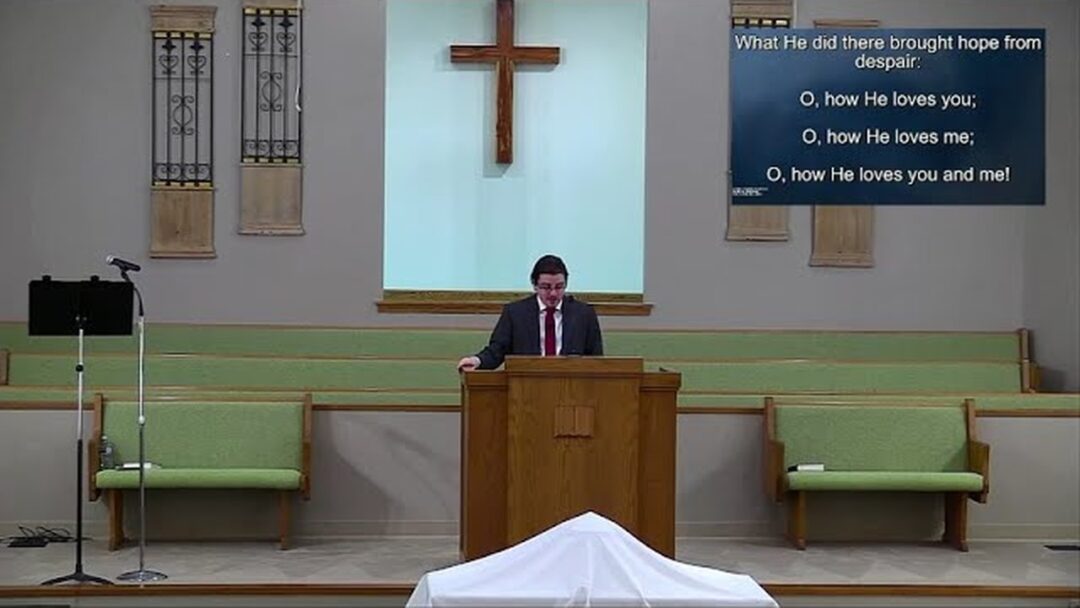
From our Sunday service on February 23, 2025, Ruth 4. This is part 4, the final message in our Ruth series. Watch the full message: The Time of Redemption – Ruth Series #4 on YouTube.
Last time we left off on quite the cliffhanger. Ruth had gone to Boaz and asked, “Will you be my family redeemer?” Then she went home, and Naomi said, “Don’t stress out. We know Boaz and his character. This very night he’s going to get this situation settled.” We’re going to conclude this series. The main idea I want everybody to take home is that God wants you to realize the beauty of redemption. God set up the concept of levirate marriage in the Old Testament to foreshadow His work of redemption on the cross. Ruth gives birth to Obed, then Jesse, then King David, and through the line of David comes the Messiah. All these thousands of years ahead of time, Jesus was being foreshadowed.
Business at the Gate
The gate of the city was where legal matters were handled. It was a public place, and there would be elderly people, too old to work but wise in their years, who could become witnesses. Boaz has decided to do everything by the book. He could have snuck off and married Ruth without telling anybody about the kinsman-redeemer problem. But he wants to do things the legal, God-prescribed way. So he sits at the gate, waits for the man, brings the elders in, and deals with this by the book.
The word “brother” doesn’t always mean they were literally brothers from the same mother or father. We don’t know for sure whether this man was a younger brother or a cousin, because the Hebrew word is used pretty loosely. But we know he was a very close relative, and there is nobody else in line after these two. Then the man says, “I will redeem it,” and he kind of interrupts Boaz mid-sentence. I don’t think he knows Naomi is still alive. This is happening within three or four months, so he may not know they’re back. He sees an easy opportunity to double his wealth, take the land, do no work, and get all the reward.
The Cost of Doing Right
Then Boaz stops him. Now the expense is double. Redemption wasn’t a free process. You’re inheriting somebody’s entire estate, years and years of wages. And not only that, you’re going to have to marry Ruth and care for her her entire life, and give her a child who will then be adopted by Naomi to inherit this land. He’d be buying it not for his children but for this woman, and the land won’t even remain his.
And the kinsman said, I cannot redeem it for myself, lest I mar mine own inheritance: redeem thou my right to thyself; for I cannot redeem it.
Ruth 4:6
His character is shown here. He doesn’t care about his responsibility as a kinsman redeemer to help his family member out of poverty and widowhood. He only cared about the financial gain, and when he finds out that the cost of doing the right thing is a lot, he says, “I can’t sacrifice my children’s inheritance for somebody else. I cannot, I will not. I’m out.” This was a very shameful thing. Under the law, if you rejected the responsibility, they would take off your shoe and have the wife spit in your face, and your name would be called “The house of him that hath his shoe loosed.” Naomi could have tracked this man down, called him into the public forum, and made him an embarrassment to his city. She had every right to, because he had abandoned his responsibility to her. Boaz is being way more gracious than he needs to be. That’s been a theme this whole time. Instead of having this man’s name publicly shamed in Israel, he sits down with him and deals with it like a responsible adult.
A sandal in this time was how they confirmed transactions. You would swap sandals to confirm a deal, kind of like a contract that just wasn’t on paper. It was on a shoe. Just as Naomi said, it was going to be dealt with that day.
Boaz Is Not Ashamed
Unlike the kinsman who was supposed to redeem Naomi, Boaz has no shame in his work of redemption.
And Boaz said unto the elders, and unto all the people, Ye are witnesses this day, that I have bought all that was Elimelech’s, and all that was Chilion’s and Mahlon’s, of the hand of Naomi. Moreover Ruth the Moabitess, the wife of Mahlon, have I purchased to be my wife, to raise up the name of the dead upon his inheritance, that the name of the dead be not cut off from among his brethren, and from the gate of his place: ye are witnesses this day.
Ruth 4:9–10
He publicly says to everyone, “I have paid the price for Naomi, for her two late sons, and for her daughter-in-law, who will become my wife.” If your spouse is that happy to announce they’re marrying you, you’re marrying a good one. He was not ashamed to say that Ruth the Moabite was going to be his wife. That might have been a little questionable. She had been a pagan a couple of months ago and had been following God for only about four months. Some people in the city may not have been as excited as he was. And yet he has no hesitation. Ruth will no longer have to scrape by in the corners of fields, or worry what happens if Naomi dies.
The people at the gate pray a blessing over the new family. They mention Rachel and Leah, and they also bring in Tamar, who gave birth to Perez. Tamar was an outsider. So they’re saying, “Ruth is a Moabite, but like Tamar, may she be grafted into our community and be blessed.” “Do thou worthily in Ephratah” is a prayer that this family would honor God in the time of the judges, when probably half the nation is struggling with idolatry. And “may your name be famous in Bethlehem” is fulfilled pretty big, because she’s going to give birth to Obed, then Jesse, then King David, the most famous king of all of Israel. Ruth was blessed to be the foremother not only of David but of Jesus Christ.
So Boaz took Ruth, and she was his wife: and when he went in unto her, the LORD gave her conception, and she bare a son. And the women said unto Naomi, Blessed be the LORD, which hath not left thee this day without a kinsman, that his name may be famous in Israel. And he shall be unto thee a restorer of thy life, and a nourisher of thine old age: for thy daughter in law, which loveth thee, which is better to thee than seven sons, hath born him.
Ruth 4:13–15
Here we already see a miracle. When Ruth was in Moab she was not able to have children. While Naomi was outside the will of the Lord, the blessings were cut off. When they entered where God wanted them to be, what was hard and impossible in Moab suddenly became natural in Israel. This may be Ruth’s child, but legally this child belongs to Naomi. Remember, at the beginning of chapter 1, after her husband and two sons died, Naomi was “left,” abandoned. She said, “God has left me alone with nothing.” Now the women around her say, “Don’t you see, Naomi? God has not abandoned you.” What seemed impossible has been fulfilled through a woman who owed her nothing, a pagan who didn’t believe in God, whose love is better than seven sons. In that society all the legal processes happened through a son. You could have a thousand daughters and it wouldn’t pass on your inheritance. But this woman loved her enough that, as a woman with no right to preserve the estate, she was used to preserve it through the will of God. They named the child Obed, “the one who serves,” as a reminder that those who serve can trust in God. Naomi took the child and became nurse unto it: in Hebrew, his adoptive mother.
Boaz and Christ, Our Kinsman Redeemer
The things written in the Old Testament were written for our examples. When Christ comes He’s going to be called the Redeemer, the one who buys back. First, both became our close relative. Boaz was a near family member. Jesus, who was God, became flesh, part of the family of humanity, so that He could redeem us. Second, both redeemed from poverty. Ruth was poor and widowed, and Boaz bought her out of that estate. We have been morally and spiritually bankrupt, with a debt we were unable to pay. There was a redeemer in our story who wasn’t willing to pay the cost. Yet we have a Savior who said, “I will pay the cost, even at My own life, even if it’s an agonizing death on the cross.” Third, both paid the ultimate price. Boaz had to redeem not just Ruth but Naomi and her whole estate. Christ purchased salvation with His own blood. Fourth, both acted out of love and grace. Boaz had no obligation to marry Ruth, and God had no obligation to redeem us. And yet while we were yet sinners, Christ came. Fifth, both provide security and a future: a new home and a new name. Sixth, both fulfilled the law. Boaz went to the gate, made the contract, and paid the fee. Jesus fulfilled all righteousness and lived a sinless life for over thirty years so that He could be a sacrifice. Lastly, both redemptions lead to joy and blessing.
If the story of Boaz and Ruth brings us such joy, how much more joy should we feel at our own story of redemption in Jesus Christ? When we’re in the will of the Lord, God will bless us and take care of us. But if we choose to say, “It’s not my responsibility, the cost is too great,” that protection will be gone. We have a God who is willing to redeem us like Boaz did for Ruth. God wants you to realize the beauty of redemption. Have you realized yet just how beautiful the work Christ has done for you is?
Recent Comments