
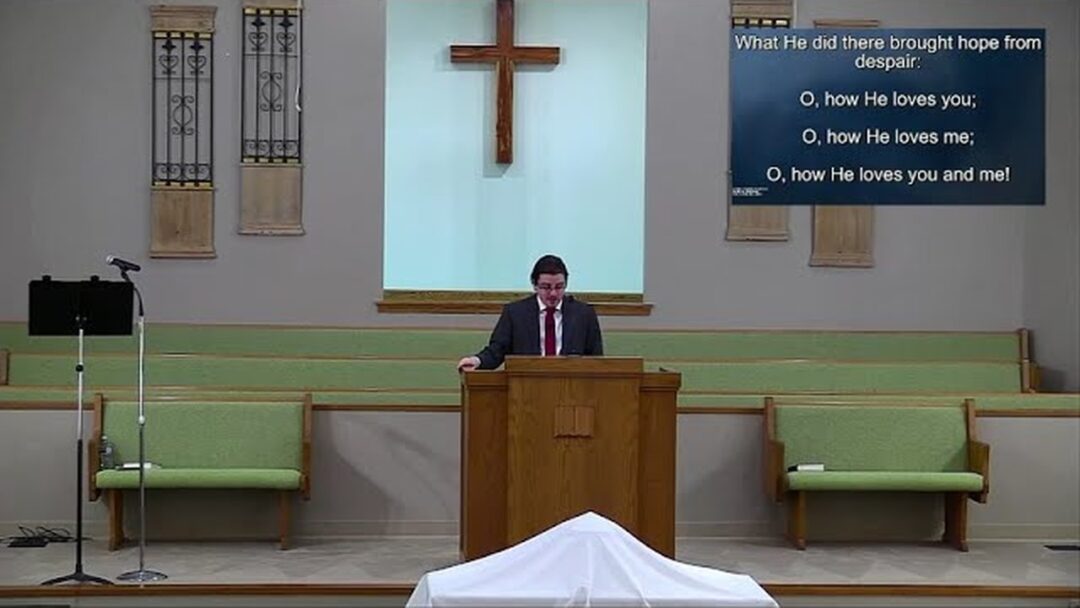
From our Sunday service on February 23, 2025, Ruth 4. This is part 4, the final message in our Ruth series. Watch the full message: The Time of Redemption – Ruth Series #4 on YouTube.
If you remember, last week we left off on quite the cliffhanger. Ruth had gone to Boaz and asked, “Will you be my family redeemer?” Then she went home and told her mother-in-law everything that had happened, and Naomi said, “Don’t stress out. Relax. We know Boaz and his character. This very night he’s going to get this situation settled, and you won’t have to worry another day.” Both Naomi and Ruth have been through a lot over these last few weeks, and today we’re going to conclude this series. I’m kind of sad about that. I’ve really enjoyed the study and sharing it with you, and I hope it’s been an encouragement to you.
Before we get into the message, I’ll read my translation of chapter 4 for those who’ve never heard the story, so we can follow along better.
Story Time: Ruth 4
Then Boaz went up to the gate and sat down there. Then consider this: the family member that Boaz spoke about passed by. So he said, “Step aside, you’re the one. Sit here.” So he stepped aside and sat down. So he took ten men of the city elders and said, “Sit here,” and they sat down. He said to the family member, “Naomi, who has returned from the land of Moab, is selling a plot of land that belonged to our brother Elimelech. So I said to reveal this thing to you, saying, ‘Buy it in the presence of the residents, in the presence of my people’s elders. If you will redeem it, redeem it. But if you will not redeem it, then tell me so I can know, because there’s no one else to redeem it except you, and I am the next after you.'” And he said, “I will redeem it.” Then Boaz said, “On the day you buy the parcel from Naomi’s hand, you must also buy it from Ruth the Moabite, the wife of the dead, to preserve the dead man’s name over his inheritance.” So the family member said, “Then I’m unable to redeem it for myself, because I would destroy my own inheritance. You redeem it for yourself. Take my right to redemption, because I cannot redeem it.” Now this custom was used in former times in Israel in redemption and in exchange, to establish all matters: a man removed his sandal and gave it to the other. This was an attestation in Israel. So since the family member said to Boaz, “Buy it for yourself,” he removed his shoe.
Ruth 4:1–8 (my translation)
Then Boaz said to the elders and all the people, “You are witnesses today that I have bought from the hand of Naomi everything that belonged to Elimelech and everything that belonged to Chilion and Mahlon. I’ve also purchased Ruth the Moabite, the wife of Mahlon, to be my wife, in order to preserve the dead man’s name over his inheritance, so the dead man’s name is not cut off from among his brothers or from the gate of his birthplace. You are witnesses today.” And all the people that were at the gate with the elders said, “We are witnesses. May Yahweh allow the woman who has entered into your household to be like Rachel and like Leah, who both built the house of Israel, and may you do virtuously in Ephrathah and have a good name in Bethlehem. May your house be like the house of Perez, whom Tamar delivered for Judah, because of the offspring that Yahweh will give you from this young woman.” So Boaz took Ruth and she became his wife, and he went to her, and Yahweh gave her conception, and she delivered a son. The women said to Naomi, “May Yahweh be blessed, who today has not left you without a family member. May his name become famous in Israel, and he will become a life restorer for you and a sustainer of your old age, because your daughter-in-law who loves you, who is better to you than seven sons, has delivered him.” So Naomi took the child, laid him in her lap, and became caregiver to him. And the residents of Bethlehem went to give him his name, saying, “A son has been delivered for Naomi.” So they called his name Obed, meaning “one who serves.” He is the father of Jesse, the father of King David.
Ruth 4:9–17 (my translation)
The Beauty of Redemption
Like I said last week, we ended on a cliffhanger. Ruth asked for Boaz’s hand in marriage, but we discovered there was already somebody who had to offer his hand in marriage first. Of course we don’t have the name of this individual. The book of Ruth spares him from shame by not mentioning his name. But we knew they had to resolve the situation, and we just read how it ends. Now we’re catching up with Boaz as he meets the man to see whether he’ll be permitted to marry Ruth and redeem her family.
The main idea I want everybody to take home today is that God wants you to realize the beauty of redemption. God set up the concept of levirate marriage in the Old Testament to foreshadow his work of redemption on the cross. These last few weeks we’ve been talking about Old Testament stories, but today we’re going to connect that story with the New Testament and how it foreshadows Jesus. You saw at the end that Ruth eventually gives birth to Obed, who gives birth to Jesse, who gives birth to King David, and we know that through the line of David comes the Messiah. All these thousands of years ahead of time, Jesus was being foreshadowed in the Old Testament.
Ruth 4:1-4: Business at the Gate
Then went Boaz up to the gate, and sat him down there: and, behold, the kinsman of whom Boaz spake came by; unto whom he said, Ho, such a one! turn aside, sit down here. And he turned aside, and sat down.
Ruth 4:1
The gate of the city was the area where legal matters were handled. It was a very public place where everybody had to go and there were always people passing by, so if you needed to settle a legal dispute, you went to the gate and there would be people there who could help you. It was sort of a public forum where disputes and legal matters could be settled. There would be elderly people available who were too old to work but wise in their years and experience, and they could become witnesses to legal decisions and verify the authenticity of a transaction if it was needed later.
Boaz has decided to do everything by the book. As I mentioned last week, he could have snuck off and married Ruth without telling anybody about the kinsman redeemer problem, saying, “I’ll just do it under the table.” But Boaz wants to do things the legal, God-prescribed way. So he says, “I need to talk to this other person who has the right. I’ll wait at the gate until he walks by, grab him aside, bring the elders in, and we’ll deal with this like mature, law-abiding citizens.” And that’s what he does. He sits down and waits for the man to show up.
And he took ten men of the elders of the city, and said, Sit ye down here. And they sat down. And he said unto the kinsman, Naomi, that is come again out of the country of Moab, selleth a parcel of land, which was our brother Elimelech’s: And I thought to advertise thee, saying, Buy it before the inhabitants, and before the elders of my people. If thou wilt redeem it, redeem it: but if thou wilt not redeem it, then tell me, that I may know: for there is none to redeem it beside thee; and I am after thee. And he said, I will redeem it.
Ruth 4:2–4
The word “brother” doesn’t always mean they were literally brothers from the same mother or father. Sometimes it’s used for other family members too. That’s why I said last week we don’t know for sure whether this man was a younger brother or a cousin, because the Hebrew word is used pretty loosely throughout the Scriptures. But we know he was a very close relative. Boaz says, “This land is available and it needs to be redeemed, and I thought it was appropriate that we gather witnesses and settle this in a public forum where there’s accountability for whatever decision we make.” He’s being very responsible. And he breaks it down: “If you’re going to redeem it, redeem it, because there’s nobody other than us. If you won’t, tell me, because I’m next.”
There are only two people involved here. We don’t know if they were actual blood siblings or cousins, but this man doesn’t have any other relatives available to redeem Naomi and Ruth. If he doesn’t, the right goes to Boaz, and there’s nobody else in line after that. So one of the two has to do it. Then the man says, “I will redeem it,” and I should mention he kind of interrupts Boaz mid-sentence to say it. Why does he do that? For one thing, I don’t think he knows Naomi is still alive. It seems he understands that Elimelech died and the family lived in Moab, and I don’t know that he knows Naomi is back, because he cuts Boaz off before he finishes explaining. I believe he wants the land for himself, to expand his inheritance for his children. He sees an easy opportunity to double his wealth. All that land they left vacant for years while they were in Moab is now available, and remember this is happening within three or four months, so he may not know they’re back. He’s thinking, “I can take this land, double my wealth, say yes, do no work, and get all the reward.”
Ruth 4:5-6: The Cost of Doing Right
Then said Boaz, What day thou buyest the field of the hand of Naomi, thou must buy it also of Ruth the Moabitess, the wife of the dead, to raise up the name of the dead upon his inheritance.
Ruth 4:5
So Boaz stops him. “You need to know there’s a little more information in this decision. When you buy it from Naomi, you’re also going to have to buy it from Ruth.” Now the expense is double. Redemption wasn’t a free process. You’re inheriting somebody’s entire estate, so it’s not going to be a couple of bucks; it’s going to be a large amount, years and years of wages. “This isn’t just Naomi’s land. She has a daughter-in-law who has a right to inherit it too, through a husband. So you have to buy the land, and not only that, you’re going to have to marry Ruth and care for her her entire life, and on top of that you’re going to have to give her a child who will then be adopted by Naomi to inherit this land.”
The entire deal has changed. He was thinking, “I can take that land, split it among my kids, and my kids will have double what they would have had. They’ll prosper, they’ll stay in my family, and my family name will be great.” Now he realizes not only does he have to pay a fee for this land, but the land won’t even remain his. He’d have to give a child to Naomi, and Naomi’s child would inherit it. He’d be buying this land not for his children but for this woman.
And the kinsman said, I cannot redeem it for myself, lest I mar mine own inheritance: redeem thou my right to thyself; for I cannot redeem it.
Ruth 4:6
His character is shown here. He doesn’t care about his responsibility as a kinsman redeemer to help his family member out of poverty and widowhood. He only cared about the financial gain for his own family, and when he finds out that the cost of doing the right thing is a lot, he says, “I can’t sacrifice my children’s inheritance for somebody else. I cannot, I will not. I’m out.”
This was a very shameful thing. Under the law, if you rejected the responsibility, you could be publicly shamed. They would take off your shoe, like they do in this transaction, and have the wife spit in your face. This whole time Naomi could have done that. She could have tracked this man down right off the bat, called him into the public forum, shamed him, and made him an embarrassment to his city and nation. She had every right to, because he had abandoned his responsibility to her.
Boaz is being way more gracious than he needs to be. That’s been a theme this whole time. With Ruth he goes out of his way not just to give her food but to give it for free, and meals and water and all that extra. Here Boaz could have said to Naomi, “Go shame the guy, get this done, I don’t need to do it.” Instead of having this man’s name publicly shamed in Israel, he goes to the man who put off his responsibility, sits down with him, and deals with it like a responsible adult. He says, “We need to talk. There’s a responsibility, and if you’re not going to do it, you need to tell me, because I’m next in line.” Naomi has been sitting in limbo for months while this man does nothing. Whether he didn’t know or ignored it, I have no idea. It seems he didn’t know, but we don’t know for sure. It sounded good to him as an opportunity to make himself rich, but the second it came at a cost to him, he said, “I can’t do it. My money is too important.” Boaz could have chosen to publicly shame him. It was this man’s job as the nearer kinsman to make sure his relatives’ widows didn’t go hungry, weren’t homeless and weren’t struggling, and he abandoned it. You would think Boaz would publicly shame him, but that’s not what happens.
Ruth 4:7-8: The Sandal
Now this was the manner in former time in Israel concerning redeeming and concerning changing, for to confirm all things; a man plucked off his shoe, and gave it to his neighbour: and this was a testimony in Israel. Therefore the kinsman said unto Boaz, Buy it for thee. So he drew off his shoe.
Ruth 4:7–8
A sandal in this time was how they confirmed transactions. I don’t know if sandals had some kind of signature on them that identified who they belonged to, but you would swap sandals to confirm a deal, and if somebody argued about it, you could go in front of the elders and say, “I have a sandal. He gave me his sandal. It’s proof we had the transaction.” It’s kind of like a contract; it just wasn’t on paper, it was on a shoe. So Boaz says, “You said you’re not doing it, so I’m doing it right now. Let’s settle this.” Just as Naomi said, it was going to be dealt with that day. He takes off his shoe and makes the deal right there.
But here’s how he could have publicly shamed this man, and he did not have to do this. Deuteronomy 25:5-10:
If brethren dwell together, and one of them die, and have no child, the wife of the dead shall not marry without unto a stranger: her husband’s brother shall go in unto her, and take her to him to wife, and perform the duty of an husband’s brother unto her. And it shall be, that the firstborn which she beareth shall succeed in the name of his brother which is dead, that his name be not put out of Israel. And if the man like not to take his brother’s wife, then let his brother’s wife go up to the gate unto the elders, and say, My husband’s brother refuseth to raise up unto his brother a name in Israel, he will not perform the duty of my husband’s brother. Then the elders of his city shall call him, and speak unto him: and if he stand to it, and say, I like not to take her; Then shall his brother’s wife come unto him in the presence of the elders, and loose his shoe from off his foot, and spit in his face, and shall answer and say, So shall it be done unto that man that will not build up his brother’s house. And his name shall be called in Israel, The house of him that hath his shoe loosed.
Deuteronomy 25:5–10
This was a permanent disgrace to a family. Here’s a little application about how we should treat our family members today. Just because they don’t live in the same household doesn’t mean we shouldn’t care for them and have their best interest at heart. In Israel, if you abandoned your in-laws after the death of a spouse, you would be publicly disgraced and called “the one who had his shoe loosed.” I don’t know how you mock people with that, it’s a mouthful, but they would mock and shame you for years, and your household would be publicly disgraced and humiliated if you didn’t take care of your family. Family is important to God. He believes in the family union and that the family should take care of each other. He put it in the law that no one should be abandoned, and that those who abandon their family should be brought to shame. Boaz has an opportunity here to shame his relative and leave a permanent scar on him, and yet he chooses to handle the situation gently and graciously.
Ruth 4:9-12: Boaz Is Not Ashamed
And Boaz said unto the elders, and unto all the people, Ye are witnesses this day, that I have bought all that was Elimelech’s, and all that was Chilion’s and Mahlon’s, of the hand of Naomi. Moreover Ruth the Moabitess, the wife of Mahlon, have I purchased to be my wife, to raise up the name of the dead upon his inheritance, that the name of the dead be not cut off from among his brethren, and from the gate of his place: ye are witnesses this day.
Ruth 4:9–10
Unlike the kinsman who was supposed to redeem Naomi, Boaz has no shame in his work of redemption. He’s not subtle, sneaky or avoiding it. He publicly says to everyone, “I want to make this clear: I have paid the price for Naomi, for her two late sons, and for her daughter-in-law, who will become my wife.” If your spouse is that happy to announce that they’re marrying you, you’re marrying a good one. He was not ashamed to say that Ruth the Moabite was going to be his wife.
That might have been a little questionable. Remember, she was a Moabite who had been a pagan a couple of months ago and had been following God for only about four months. I’m sure some people in the city weren’t as excited about it as he was. Maybe they hadn’t heard about Ruth’s character and all she’d done for her mother-in-law, or they questioned whether a Moabite could follow God like that. And yet he has no shame and no hesitation in declaring the marriage. Ruth has now been saved from her dangerous situation. No longer will she have to go to the corners of fields and scrape by, and no longer will she have to worry, “What if Naomi dies? Where will I live? What will my inheritance be?” The situation has been solved, and she is going to have her place in Israel forever.
And all the people that were in the gate, and the elders, said, We are witnesses. The LORD make the woman that is come into thine house like Rachel and like Leah, which two did build the house of Israel: and do thou worthily in Ephratah, and be famous in Bethlehem: And let thy house be like the house of Pharez, whom Tamar bare unto Judah, of the seed which the LORD shall give thee of this young woman.
Ruth 4:11–12
In other words, the transaction is complete, and the people pray a blessing over Boaz’s new family. I said some people might not have been fans, but obviously some were. They mention Rachel and Leah, Israel’s wives, and pray, “May you have a multitude of children, just like Rachel and Leah.” They also bring in Tamar, who gave birth to Perez. What’s interesting is that she wasn’t from the same family group. She was an outsider. So they’re saying, “Ruth is a Moabite, outside the nation of Israel, but like Tamar, may she be grafted into our community and be blessed.”
They also say, “Do thou worthily in Ephratah and be famous in Bethlehem.” They’re saying, “May your family be one that honors God and walks worthy of the name of Israel.” Remember, this is during the time of the judges. Probably half the nation is struggling with idolatry right now, and they pray, “May your family be faithful to God and follow him worthily.” And “may your name be famous in Bethlehem” is fulfilled pretty big if you know where the story is going, because she’s going to give birth to Obed, who’s going to give birth to Jesse, who’s going to give birth to King David, the most famous king of all of Israel. Ruth was blessed to be the foremother not only of David but of Jesus Christ. The prayer is answered. These blessings point us toward Christ Jesus, the future Messiah who would bless all nations.
Ruth 4:13-17: From Emptiness to Blessing
So Boaz took Ruth, and she was his wife: and when he went in unto her, the LORD gave her conception, and she bare a son.
Ruth 4:13
Here we already see a miracle. If you remember all the way back to the first chapter, when Ruth was in Moab she was not able to have children. Mahlon and Chilion were not able to have their own offspring. While Naomi was outside the will of the Lord, the blessings were cut off. When Naomi returned, and Ruth returned with her, and they entered where God wanted them to be, what was hard and difficult and impossible in Moab suddenly became natural in Israel. Ruth may not have had children in that marriage in Moab, but the second she married in God’s will, the problems went away, the pathway was clear, the blessings came pouring out, and immediately she gave birth to a son.
And the women said unto Naomi, Blessed be the LORD, which hath not left thee this day without a kinsman, that his name may be famous in Israel. And he shall be unto thee a restorer of thy life, and a nourisher of thine old age: for thy daughter in law, which loveth thee, which is better to thee than seven sons, hath born him.
Ruth 4:14–15
This may be Ruth’s child, but she’s not going to keep him for very long. Part of the kinsman redeemer role is that the child needs to be given back to the widow to restore the inheritance. Legally this child belongs to Naomi, and Naomi will raise him, and when he is old he will inherit his adopted father’s estate. The women are saying, “Naomi, you are so blessed by God in your old age to have a child to call your own. God has not left you.”
Remember at the beginning of chapter 1, after her husband and two sons died, Naomi was “left.” That word means abandoned, the only one that remains. When she was down in Moab, she said, “God has abandoned me. God has left me alone with nothing.” Now, in Israel and in God’s will, the women around her say, “Don’t you see, Naomi? God has not abandoned you. He has not left you with nothing.”
What seemed impossible, another child, and someone taking you in levirate marriage, has been fulfilled. It didn’t happen the way you would normally think. Normally someone would marry Naomi, but she was too old to have children. It seemed hopeless, like her family name would be cut off. But hasn’t God worked in a miraculous way, through a woman who owed you nothing, your daughter-in-law, a pagan who didn’t believe in God? This woman says she loves you, and her love for you is better than seven sons. In this society that was a pretty big thing to say, because all the legal processes happen through a son. You could have a thousand daughters, and it wouldn’t do you any good in the legal system to pass on your inheritance. But what was impossible has become possible through Ruth. Usually you’d have to have a son to preserve your inheritance, but this woman loved you enough that, as a woman with no right to preserve your estate, she was used to preserve it through the will of God.
Naomi was abandoned in a foreign country with no hope. She says, “I fought God this whole time. I’m going back where God wants me to be.” She returned, God took care of her, and everyone in her community saw the change in her life and confirmed it to her: “You are not left today without a kinsman or an heir.” Naomi no longer had to worry about being too old to take care of herself or rely on Ruth to take care of her. She now has Boaz, and when this boy grows older he’ll be able to work and take care of her as well.
And Naomi took the child, and laid it in her bosom, and became nurse unto it. And the women her neighbours gave it a name, saying, There is a son born to Naomi; and they called his name Obed: he is the father of Jesse, the father of David.
Ruth 4:16–17
“Nurse” means he became his adoptive mother. That’s what the word means in Hebrew. And the neighbor women gave him a name: Obed, which means “the one who serves.” Naomi realized the whole lesson of all this: when you serve the Lord, you are blessed. When she was in Moab she was out of God’s will. When she was running away from responsibility she was out of God’s will. She refused to serve the Lord in Israel, where they were to settle and multiply and take the territory. Remember, this is during the time of the judges, when their main responsibility was to grow into the land and build up a society. Naomi had run away from that and refused to serve God in what she was called to do. Now, when she comes back, she says, “I’m going to serve God. I have nothing left to lose. I’m going to go back to where I should be.” Her neighbors named the child Obed, “the one who served is blessed,” as a reminder to everyone that those who serve can trust in God.
At the end we have the genealogy that links her to David. So through this whole story we see a story of redemption: one who gets out of God’s will, learns from her mistakes, and goes back to where she’s supposed to be, and we see God restore her and care for her. The truth is that God does the same for us today.
Boaz and Christ, Our Kinsman Redeemer
Before I close, I want to tie in how this passage and the previous ones foreshadow Christ as our kinsman redeemer. The Bible tells us that the things written in the Old Testament were written for our examples and for our learning. One of them is the concept of the kinsman redeemer, because when Christ comes he’s going to be called the Redeemer, the one who buys back. So let’s look back over what Boaz did with that theology of Christ in mind.
First, both became our close relative. Boaz was a near family member, which means he could redeem Ruth. Jesus Christ, who was God, became flesh. He became like us and part of the family of humanity so that he could redeem us through the cross.
Second, both redeemed from poverty. Ruth was poor and widowed with no means to provide for herself, and Boaz bought her and freed her from that poverty-ridden estate. We as mankind have been morally bankrupt and enslaved in sin, spiritually bankrupt, lost in sin with a debt we were unable to pay on our own. But Jesus Christ redeemed us and paid the cost with his own blood. Remember, there was a redeemer in our story today who wasn’t willing to pay the cost. He said, “It’s too much, it’s more than I can bear.” Yet we have a Savior who said, “I will pay the cost, even at my own life, even if it’s an agonizing death on the cross.”
Third, both paid the ultimate redemption price. Boaz redeemed Ruth at great cost to himself. He didn’t have to redeem just Ruth but also Naomi and her whole estate, buying all of Naomi’s land so that the marriage could go forward. Christ purchased salvation with his own blood, not holding back any part of himself but fully sacrificing himself for our salvation.
Fourth, both acted out of love and grace. Boaz had no obligation to marry Ruth. It was the other family member’s responsibility first, and Boaz didn’t need to step up, go to the city gate, and work out the situation. Yet he went and sought out redemption. God had no obligation to redeem us from our sins. We choose to sin, and there’s no obligation for God to come down, forgive us, and die for us. And yet while we were yet sinners, Christ came to redeem us. He willingly gave himself for us out of his love.
Fifth, both provide security and a future. Boaz gave Ruth protection, a new home and a new family name. Christ gives us his protection, a new home with him in glory, and also a new name.
Sixth, both fulfilled the law to redeem us. Boaz fulfilled the law of levirate marriage to redeem Ruth. He went to the city gate, sought the legal counsel, made the contract, and paid the fee. Jesus, in Scripture, says he fulfilled all righteousness and all requirements of the law, that is, he lived a sinless life in order to redeem us. That had a big cost. He lived on this earth for over thirty years to successfully live life without sin so that he could be a sacrifice on the cross. He fulfilled the law and the prophets in order to redeem us.
Lastly, both redemptions lead to joy and blessing. Boaz’s redemption of Ruth led to joy and blessing for both her and Naomi. They lived in comfort, without fear, and with love. Jesus’ redemption brings us joy and salvation. It includes us in the kingdom of God, and we get to live and enjoy Christ’s love in our day-to-day lives.
Realize the Beauty of Redemption
If the story of Boaz and Ruth brings us such joy and hope, how much more joy should we feel at our own story of redemption in Jesus Christ? Boaz was the forefather of David and eventually of Jesus Christ himself. Boaz’s story foreshadows Christ and what Christ would ultimately do for us, and today we can look back on that gift with joy for all the things God has given us.
We need to remember the story of the whole book most of all: when we’re in the will of the Lord, God will bless us, he will provide for us, and he will take care of us. But if we choose to stray, if we choose not to serve the Lord, if we choose to say, “It’s not my responsibility, the cost is too great,” then that protection will be gone from us. But we have a God who is willing to redeem us and care for us like Boaz did for Ruth, and I hope that brings you great joy. God wants you to realize the beauty of redemption. Have you realized yet just how beautiful the work Christ has done for you is?

Recent Comments