
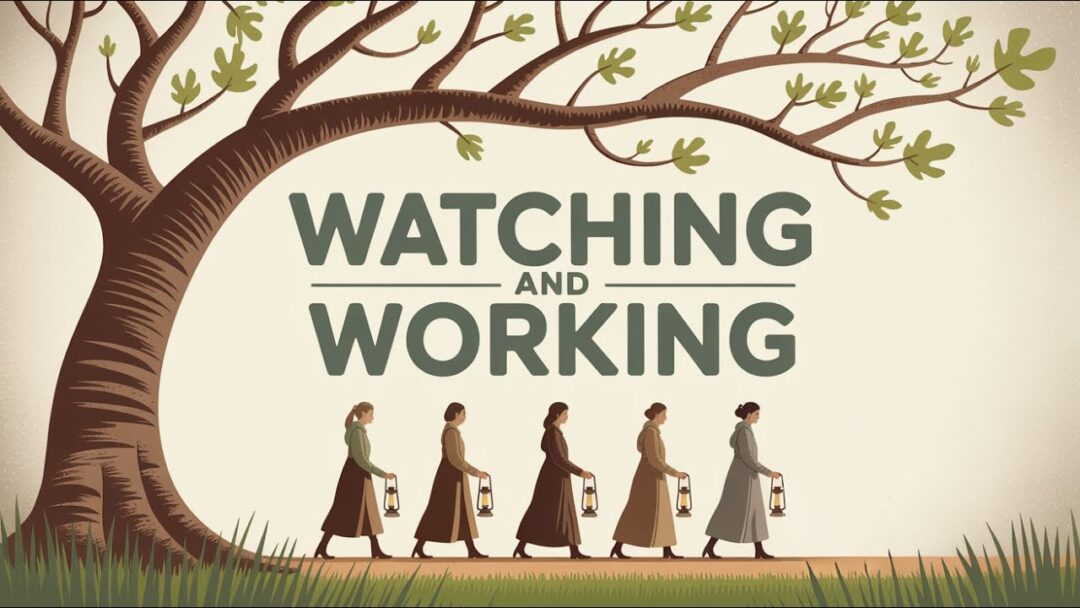
From our Sunday service on October 26, 2025, Matthew 24, Matthew 25 and Luke 12. This is part 11 of our Parables of Christ series. Watch the full message: Watching and Working – The Parables of Christ #11 on YouTube.
Last time we talked about using our skills and opportunities for the kingdom. Today we continue that idea as we talk about working for Christ as we await His return. If we have served Him, we will find praise. If we have neglected that responsibility, we will find shame, not because God condemns us, but because our own guilty conscience will condemn us. God wants you to live your life as if He may return at any moment. We may not know whether it will be in our lifetime, but we must each live as if He is coming today.
The Fig Tree, and Who Decides the Day
The context is important. Jesus warns His followers not to believe false teachers who claim He has returned and simply has not revealed Himself yet. Most cults have something to do with a secret revelation. He says His return will be like lightning from east to west: quick, bright, and loud, with a trumpet. When Jesus comes, everyone will know it.
Is this the rapture or the second coming? He says, Immediately after the tribulation, the sun will be darkened, the tribes of the earth will mourn, and they will see the Son of man coming in the clouds. So this is not the rapture. This is the second coming, when He returns for the day of wrath.
Now learn a parable of the fig tree; When his branch is yet tender, and putteth forth leaves, ye know that summer is nigh: So likewise ye, when ye shall see all these things, know that it is near, even at the doors. Verily I say unto you, This generation shall not pass, till all these things be fulfilled. Heaven and earth shall pass away, but my words shall not pass away. But of that day and hour knoweth no man, no, not the angels of heaven, but my Father only.
Matthew 24:32–36
In Palestine they waited for the fig trees to sprout in late spring before planting for the summer harvest. You may not know exactly how the weather will work, but when the fig tree sprouts, you know it is time to prepare. In the same way, things will get very hot before the second coming: conflict, war, and difficulty. Those who are watching may not know the exact day, but they will know it is approaching.
There are generally three interpretations of “This generation shall not pass.” Some say it was Jesus’s own generation, fulfilled around AD 70 to 100. Some say it is metaphorical. Others say that when the signs begin, that generation will not pass until all these things are accomplished. Comparing the options with the context, I agree with the last one. People will see the signs and say it has to be within the next seventy-five years or so.
He also says no man knows the day or the hour, not the angels, but the Father only. It happens a couple of times every year that somebody says, I know the Lord is coming back this week. Do not believe them. His word does not change.
What is interesting is that this implies Jesus Himself, at that moment, also does not know the day. Some Christians understand this as an open view of the future: God may not yet have decided the exact timing, and it may be based on what humanity does. I cannot give you a clear answer on whether God already knows the exact day or is waiting for the world to be in the right situation. God does not tell us. But in the days of Noah, the flood came because the wickedness of man had become great, not because of a date announced in advance. It is well within the possibility that the second coming will come when humanity falls away again, and that we have a part to play. If we continue to preach the gospel and lives are saved, maybe it will not happen quite as quickly.
People often take the next verses the wrong way and say that those who are taken in the field are the righteous in the rapture. But in context this happens after the tribulation, so it cannot be the rapture. Go back to the flood, which took them all away. That “taken” is not a good thing. The one taken in the field is the wicked who meets the wrath of God. The wicked will be taken during their daily activities, unaware. For us who have put our faith in Christ, it will be a time of restoration. So the warning is:
Watch therefore: for ye know not what hour your Lord doth come.
Matthew 24:42
The Ten Virgins and the Watchful Servant
The parable of the ten virgins compares Christ’s return to a wedding. In that culture, after betrothal the bridegroom went to his father’s house and built an extension, and he could come for his bride at any time. The wedding party had to be ready. This is the idea behind meeting the Lord in the air. In the ancient Near East, when a king came to your city, you went out to meet him and walked him in.
All ten had lamps, but only the wise brought extra oil. The lamps represent one’s capacity for salvation. Christ says He will draw all men unto Him. The oil is the acceptance of salvation, the fuel of the Holy Spirit. God first draws us and gives us a little oil, a taste of the heavenly calling, but not everybody accepts the gift. The foolish received the call, but they never went and got the rest. Unlike some parables, there are no obvious villains here. They all care about the bridegroom to some extent. One group was professing love. The other was acting on it. When the bridegroom delayed and then the cry came at midnight, the foolish had run out. Nobody can borrow another person’s oil. We are each responsible for preparing ourselves, and nobody can make that decision for us.
In Luke 12, Jesus talks about servants with their loins girded and their lights burning, ready to open immediately when their lord returns from a wedding. Having your loins girded meant tucking up your robe so you could run. And then something seems backwards: the lord will gird himself and serve the faithful servants. Would you say that is unbiblical? Remember the Last Supper, when Jesus washed His disciples’ feet. Here we see that picture again. Because of their faithfulness, He serves them as a blessing.
He also compares His coming to a thief in the night. If you knew when a thief would break in, you would be ready. We know He is coming, and His word shall not pass away. Peter asks whether this parable is just for the disciples or for all. Jesus answers, in effect, that it is for whoever is faithful and wise over what God gave him, whether pastors, deacons, congregation, or a believer who cannot even meet publicly. The one found doing his Lord’s work will be blessed, even made ruler over all that He has. I would never expect my Lord to come and serve me. Jesus says, Expect it.
But if that servant says in his heart that his lord delays, and begins to beat the others and to be drunken, he will be cut in sunder and appointed his portion with the unbelievers. Those who knew the Lord’s will and prepared not shall be beaten with many stripes. And those who knew not, and did things worthy of stripes, shall be beaten with few stripes.
But he that knew not, and did commit things worthy of stripes, shall be beaten with few stripes. For unto whomsoever much is given, of him shall be much required: and to whom men have committed much, of him they will ask the more.
Luke 12:48
That raises a great debate: what happens to those who were never told the gospel, unreached people on remote islands? Here it says they will be beaten with few stripes. We know our God is faithful and merciful. We do not know exactly what that looks like, but there will be some kind of punishment, less than for those who rejected Him or were apathetic. What matters more for us is that the more we know, the more He holds us responsible. As a pastor I am doubly accountable, because I teach the gospel. And we as Christians are more accountable than the unsaved. If you are not going to live for God, it is better that you not come to church at all than to come and hear every week how you should live and then refuse. I am not saying drop out of church. I am saying you need to understand the risk. Those who have heard how God said to love your neighbor, and yet do not, will have to give account, and there will be severe shame.
Be in the group that is faithful, with oil in the lamp and the belt on, ready to run, watching for the signs, and working because He is coming soon. The fig tree reminds us to watch. The ten virgins remind us that no one can borrow another person’s faith. The watchful servant reminds us to stay faithful in our work. God wants you to live your life as if He may return at any moment. Will you live in light of His return?
Recent Comments