
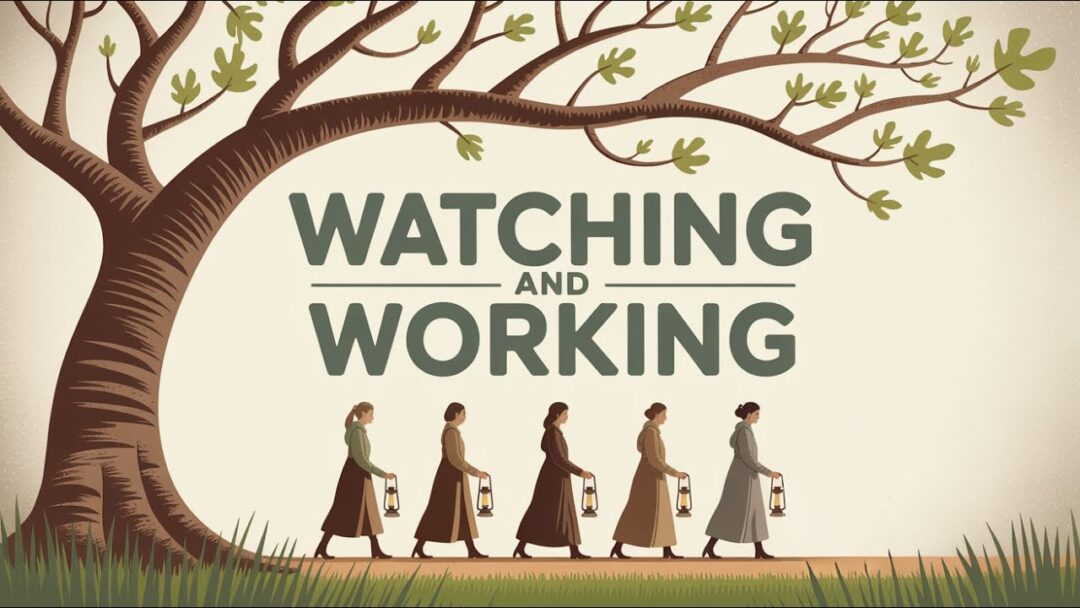
From our Sunday service on October 26, 2025, Matthew 24, Matthew 25 and Luke 12. This is part 11 of our Parables of Christ series. Watch the full message: Watching and Working – The Parables of Christ #11 on YouTube.
Last week we talked about how God wants us to use our skills and opportunities for the kingdom of heaven. Today we continue that idea as we talk about how we must work for Christ as we await his return as our coming king. It’s great that we serve on earth, but that’s not the end of the Christian journey. Eventually we will meet the Lord. These past few parables have been parables of warning, and this one is a warning too. When we meet the Lord, if we have served him, we’ll find praise. If we have neglected our responsibility to serve him, we’ll find shame, not because God condemns us, but because our own guilty conscience will condemn us.
Today we’ll look at three parables to learn this lesson: God wants you to live your life as if he may return at any moment. We may not know whether it will be in our lifetime or a generation or two or more from now, but we must each live as if he is coming today.
The Fig Tree’s Branch
First, the context. Hopefully by now you’ve noticed that I always talk about context. Good, because I’m teaching you how to study the Bible. Whenever you hear someone say, “The Bible says this,” the first thing to do is go a couple of verses above and see what the context is. Matthew 24:26-27:
Wherefore if they shall say unto you, Behold, he is in the desert; go not forth: behold, he is in the secret chambers; believe it not. For as the lightning cometh out of the east, and shineth even unto the west; so shall also the coming of the Son of man be.
Matthew 24:26–27
These two verses give us the immediate context for the parable. Jesus is telling his followers not to believe false teachers who claim he has returned and simply hasn’t revealed himself yet. There will be plenty of people, before now and after, who say Jesus has come and not revealed himself. Most cults have something to do with a secret revelation: “Jesus told me this secret thing, and he told me to work this area because he’s going to reveal himself later.” Jesus, in his infinite wisdom, warned us in Scripture: if anybody tells you I’ve come and I’m just waiting to reveal something, do not believe them.
He says his return will be like lightning flashing from east to west. Jesus will come at the speed of light from one end of the earth to the other. It will not be a slow or secretive project. How often have you missed a lightning strike? Our instinct is to make a comment about it: “Did you hear that?” as if the person next to you were deaf. We always comment on lightning because it’s so noticeable. Jesus uses it as the perfect illustration. His coming will be quick, bright and loud, and his coming comes with a trumpet sound, as we’ll see. So if somebody tells you the Lord has started his return on the earth but hasn’t revealed himself, don’t believe it. When Jesus comes, everyone will know it.
Are we talking about the rapture or the second coming? Let’s find out. Verses 28 to 31:
For wheresoever the carcase is, there will the eagles be gathered together. Immediately after the tribulation of those days shall the sun be darkened, and the moon shall not give her light, and the stars shall fall from heaven, and the powers of the heavens shall be shaken: And then shall appear the sign of the Son of man in heaven: and then shall all the tribes of the earth mourn, and they shall see the Son of man coming in the clouds of heaven with power and great glory. And he shall send his angels with a great sound of a trumpet, and they shall gather together his elect from the four winds, from one end of heaven to the other.
Matthew 24:28–31
Verse 28 gives us a big hint. “Wheresoever the carcass is, there will the eagles be gathered together” tells us this is a very violent event. Verse 29 gives us even more of a clue: “Immediately after the tribulation.” So this isn’t the rapture. This is the second coming of Jesus Christ, when he returns for the day of wrath, to pour out wrath on the wicked and begin a new era. All the tribes of the earth will mourn because God’s great day of judgment has come, the day for the wicked to pay the price for their wickedness. With this context, we’re given a parable about the signs of the second coming. Verses 32 to 34:
Now learn a parable of the fig tree; When his branch is yet tender, and putteth forth leaves, ye know that summer is nigh: So likewise ye, when ye shall see all these things, know that it is near, even at the doors. Verily I say unto you, This generation shall not pass, till all these things be fulfilled.
Matthew 24:32–34
This is a very short parable, but there’s a lot to digest. The simple premise is that when you see the fig tree begin to put out new leaves, you know that summer is coming. This was important because in Palestine they would wait for the fig trees to sprout in late spring before planting their seeds for the summer harvest. When they saw the fig tree sprout, they knew it was time to start planting so they could maximize their yield. You may not know exactly how the weather is working this year, but when the fig tree sprouts, you know it’s time to start preparing, working, watching and waiting. It was an indicator to prepare for the hot but profitable summer growing season.
In the same way, things are going to get real hot before the second coming. There will be a lot of conflict, a lot of war and a lot of difficulty before the day of wrath ends everything and a new era begins. But Jesus says it won’t come completely unexpectedly. You can’t know exactly when the hottest days of summer will come, but you can have a general idea by watching how the other plants are reacting to the season. In the same way, we can watch the signs of the times he has given us to know that his return is approaching. We are told about events in prophecy that will signify that Jesus will return, and those who are watching may not know exactly when, but they will know it is coming and will anticipate it.
There’s a very interesting line in verse 34: “This generation shall not pass, till all these things be fulfilled.” There are generally three interpretations. Some say the generation is that of Jesus and his disciples, and that the prophecies about the end times would be fulfilled around AD 70 to AD 100. Some say the statement is metaphorical, meaning it will happen in a reasonable time frame. Others say it’s a future generation: when the signs begin, that generation will not pass until all these things are accomplished. Comparing the options with the context, I agree with the last one. Jesus’s immediate context was that his coming would happen rapidly, like lightning, and he wouldn’t hide or take time to reveal himself. So I believe the passage means that when the signs begin, that generation will not pass away before his whole plan and his coming have been revealed. While people may not know the day or the hour, they will know the general time frame. They will see the signs and say, “It has to be within the next seventy-five years or so. All the prophecies have lined up.”
Verses 35 and 36:
Heaven and earth shall pass away, but my words shall not pass away. But of that day and hour knoweth no man, no, not the angels of heaven, but my Father only.
Matthew 24:35–36
After the second coming the world is going to be changed, remade and reworked. We’re going to have a new heaven and a new earth. Everything we’ve worked on here is going to pass away, and we’re going to get a fresh new start. But Jesus says his words will not pass away. In other words, he speaks the truth, what he tells us is trustworthy, and no matter what anybody else tells you, it will not change. When he says he’s coming, he’s coming. When he says it’s going to happen quickly, it’s going to happen quickly. Take him at his word. And he reminds us again that no man knows the day or hour. It happens a couple of times every year that somebody with a following says, “I know the Lord’s coming back this week.” Jesus so earnestly and clearly says, “Do not believe them.” When somebody tells you he has revealed something to them that Jesus has told you he’s not revealing, don’t believe them, because his word does not change. You may change your mind, but God never does.
Who Decides the Day?
What’s interesting is that the angels don’t know, but only the Father knows. Jesus says no human being knows the day or hour, but here it implies that Jesus himself also doesn’t know at this moment. Some Christians understand this as what we’d call an open view of the future: God may not yet have decided the exact timing of the second coming, and the date of Christ’s return is based on what humanity decides to do in regard to following Christ. God will look at the condition of the earth, and when it is time he will say it’s time, and Christ will come. Then only God would know, since he is the one who makes the decision based on humanity’s future choices.
I watched a short video this week that explained free will really well. It put it in two categories: what is above and what is below. Below are the things on this earth. In Genesis, God gave mankind dominion over the earth. When we decided we wanted to sin, God said, in effect, “I gave you rule over the earth. If that’s the decision you want to make, I’ll allow it, even though it’s to your own destruction.” You decide what shirt you’re going to wear, whom you’re going to marry, whether you’re going to follow Christ, because God has put that into your hands. But then there is what is above, the things over which God has sovereignty. God ultimately has decisions over what difficulties are allowed to happen in our lives. If you notice anything in Scripture, you’ll find that God never corrects the unbeliever, but he often corrects the believer. When you submit yourself to God, you put yourself under his sovereignty and give him some authority over your life. Whom the Lord loves, he corrects. So those who don’t believe live on “below” free will, and the believer lives on “above” free will. The sinner may not see correction from God, but you can bet the believer will when he goes the wrong direction.
When it comes to prophecy, mankind has no ability to thwart God’s plan. When God said that Israel would serve Babylon seventy years and then return to their promised land, you can bet that was going to happen, because God said he would do it. It didn’t matter which leader was in charge of Babylon or what the other world powers were doing. When the time came, God was going to do with his people what he wanted. So we have a question: does the second coming fall into the category of things above, because God is the one doing it, or things below, because it responds to what people on earth do? I can’t give you a clear answer on whether God knows exactly what day it is or is waiting for the world to be in the right situation. God doesn’t tell us. But it’s possible that the coming only comes when the earth is in the right condition, and that we have a part to play in when it happens. In the next verses, Jesus compares it to the days of Noah. What determined when the flood came? Not a pre-ordained plan, but because the wickedness of man had become great. So I think it’s well within the possibility that the second coming will come when humanity decides to fall away from God again, and Revelation shows that pattern of falling away before the Lord’s return. Like the days of Noah, it may be determined mostly by how we as Christians do our job. If we continue to preach and teach the gospel and lives are saved, then maybe the second coming won’t happen quite as quickly. Maybe God will allow his ministry to continue so that more accept the gospel. Verses 37 to 42:
But as the days of Noe were, so shall also the coming of the Son of man be. For as in the days that were before the flood they were eating and drinking, marrying and giving in marriage, until the day that Noe entered into the ark, And knew not until the flood came, and took them all away; so shall also the coming of the Son of man be. Then shall two be in the field; the one shall be taken, and the other left. Two women shall be grinding at the mill; the one shall be taken, and the other left. Watch therefore: for ye know not what hour your Lord doth come.
Matthew 24:37–42
Why did the flood of Noah come? Wickedness on the earth was great. Sin had become uncontrolled, and people were eating and drinking and marrying, going about life like nothing was wrong. Did Noah tell them the flood was coming? You can bet. Do we tell people the Lord will return one day? You can bet. But because people disregarded the warning, the flood took them by surprise. The same thing will happen when the Lord returns. It’s likely the second coming will occur during a period of extreme wickedness, when no one listens to the few righteous who remain.
I often see verses 40 to 42 taken the wrong way. People say that those who are taken are the righteous and that this is the rapture. But in its context this happens after the tribulation, so it can’t be the rapture. The word “taken” is usually interpreted by our group as a positive thing, but go back to verse 39, where it’s used negatively: “and knew not until the flood came, and took them all away.” That “taken” is not a good thing. The people the flood took did not have a good experience. In the same way, the one taken in the field is not in heaven. The one taken is the wicked who meets the wrath of God. At the second coming the wicked will be taken during their daily activities, unaware of the judgment coming. They’ll be farming, working in a mill, doing their daily routines, and suddenly the wicked will die in their sin and the righteous will live. So we have the warning in verse 42: “Watch therefore: for ye know not what hour your Lord doth come.” Make sure you’re in the right group. To those of us watching, the timing will be obvious. For the wicked it will be a time of surprise and great destruction. For us who have put our faith in Christ and awaited his return, it will be a time of restoration.
The Ten Virgins
Now the parable of the ten virgins, Matthew 25:1-4.
Then shall the kingdom of heaven be likened unto ten virgins, which took their lamps, and went forth to meet the bridegroom. And five of them were wise, and five were foolish. They that were foolish took their lamps, and took no oil with them: But the wise took oil in their vessels with their lamps.
Matthew 25:1–4
Once again, Christ’s return is compared to a wedding, a common theme in Scripture. In Revelation it’s called the marriage supper of the Lamb, when the Lord has the second coming and takes his bride home for all eternity. In this culture, a betrothal was the equivalent of our engagement period. During it, the bridegroom would go to his father’s house and build an extension for his wife. Whether directly attached or separate, when the house was finished, at whatever time it was finished, he would come to take his bride to their new home. So the wedding party had to be ready 24/7, 365, for the bridegroom to come. Here we meet ten young women responsible for escorting the bridegroom to the bride to begin the wedding.
This is the idea behind meeting the Lord in the air. It comes from the ancient Near Eastern tradition that when a king came to your city, you went and met him outside the city first and then walked with him in. It’s like meeting your guest at the front door and walking them in, rather than saying, “Come on in, I left it unlocked.” We meet the Lord in the air because we are ushering in our king with respect.
But half of these young women were foolish. They put oil in their lamps and lit them, but brought no extra oil. The bridegroom could come in the middle of the night, and if he comes at night, the only way you can go anywhere is if you can see. All ten had a lamp, but not all had brought the oil to keep it burning.
The lamps represent one’s capacity for salvation. Each of us has the capacity to be saved. Christ says, “I, if I be lifted up from the earth, will draw all men unto me,” not just some. The acceptance of salvation is the oil they needed to keep the light burning. The Bible says God first draws us into salvation, and if he didn’t draw us first we would never be saved. So God gives us a little oil to draw us in, the light and fuel of the Holy Spirit for a moment, to convict us and bring us to him. These foolish women had received the oil of the Holy Spirit, the call, a taste of the heavenly calling, but they never went and got the rest. They burn their fuel while waiting. Not everybody accepts the gift.
Notice that in this parable, unlike the others, there are no good and bad people. They all care about the bridegroom. They like him to some extent. They’re all “friends of the family.” Some were just more interested than others and willing to go out of their way to do something about it. If you asked them, both groups would say they cared about the bridegroom, but only one group would put in the effort to prepare for him. One was professing love while the other was acting on it. Verses 5 to 9:
While the bridegroom tarried, they all slumbered and slept. And at midnight there was a cry made, Behold, the bridegroom cometh; go ye out to meet him. Then all those virgins arose, and trimmed their lamps. And the foolish said unto the wise, Give us of your oil; for our lamps are gone out. But the wise answered, saying, Not so; lest there be not enough for us and you: but go ye rather to them that sell, and buy for yourselves.
Matthew 25:5–9
“Tarried” means delayed. Suddenly the bridegroom blows the horn, which is a parallel to the trumpet call at the Lord’s return. Everybody wakes up. Don’t get mad at the ones for sleeping, because everybody slept. Everybody trims their lamps and gets the wick ready, but not everybody has fuel, because while they were sleeping some of them ran out. What good is preparing the lamp if there’s no fuel for it? Those who were ready went with the bridegroom to the wedding. Those who were unprepared had to go to the market and buy oil in the middle of the night, and by the time they made it back, the door was shut. Because the bridegroom had never met them, he didn’t know who they were. Just like in the other parable, when they knock on the door, he says, “Go away, you’re a stranger.” In the other parable they said, “We heard you teach in the streets, rabbi,” and he said, “I don’t have a relationship with you.” He had never met them, and when it was time to meet and greet, they weren’t ready.
Once again we receive the warning: be ready, because you do not know when Christ will come. We are each responsible for preparing ourselves for the Lord’s return, and nobody can make that decision for us. We must be faithful to Christ personally if we want to be rewarded by him.
The Watchful Servant
Our last parable today is the parable of the watchful servant, Luke 12:32-48. We touched on part of this earlier in the series, but there’s more context in Luke that fits better with today’s theme, so we’ll look at it from a slightly different perspective. Verses 32 to 34:
Fear not, little flock; for it is your Father’s good pleasure to give you the kingdom. Sell that ye have, and give alms; provide yourselves bags which wax not old, a treasure in the heavens that faileth not, where no thief approacheth, neither moth corrupteth. For where your treasure is, there will your heart be also.
Luke 12:32–34
This is our context. You may remember it from our earlier message on the kingdom treasure. Jesus is talking about our investment in the kingdom: “Where your treasure is, that’s where your heart will be.” So this parable is about giving up earthly treasures to receive heavenly ones. Stop storing up riches for yourself on the earth. Stop letting riches be your god. Sell what you have and give to those who are less fortunate. Care about someone other than yourself. When you have money in the bank, it’s always losing value, no matter what you do. Jesus is asking, “Do you want to invest in something that’s not losing value? Invest in my kingdom.” Then he gives the parable. Verses 35 and 36:
Let your loins be girded about, and your lights burning; And ye yourselves like unto men that wait for their lord, when he will return from the wedding; that when he cometh and knocketh, they may open unto him immediately.
Luke 12:35–36
This sounds familiar: “your lights burning.” Having your loins girded means having your robe tied around your waist so you’re ready to move. If you wanted to run in the robes of those days, you’d trip on the tail of your robe, so they would pull up their skirts, tuck them into the belt and tighten it so the robes weren’t dangling around their feet. Jesus uses this as an illustration: don’t be unprepared. Be ready to run when your Lord returns, because he’s coming quickly. And have your lights burning, like men waiting for their lord at a wedding. When the wedding time came, the bridal party had to be ready to go. When Jesus comes and knocks, we need to open up immediately. Here the picture is a group of friends, the whole family and friends, waiting for their friend to come home from a wedding, to celebrate for a week this wonderful marriage union. This represents the marriage between Christ and his church. Verses 37 and 38:
Blessed are those servants, whom the lord when he cometh shall find watching: verily I say unto you, that he shall gird himself, and make them to sit down to meat, and will come forth and serve them. And if he shall come in the second watch, or come in the third watch, and find them so, blessed are those servants.
Luke 12:37–38
You may have noticed that something seems backwards here. The bridegroom is going to come and serve the servants. Wait, God is going to serve us? Don’t we usually talk about us serving God? Would you say that’s unbiblical? Do you remember the Last Supper, when Jesus bent down and washed the feet of his disciples? Here we see that picture again in prophecy, in regard to us as his faithful servants. Instead of the servants serving the Lord, the Lord gets down on his knees and serves the faithful who waited for his return. These servants didn’t know when he would come, in the second watch or the third, any watch of the night. They loved their Lord so much that they were always prepared to receive him. Because of their faithfulness and excitement for the kingdom, he serves them as a blessing. Verses 39 and 40:
And this know, that if the goodman of the house had known what hour the thief would come, he would have watched, and not have suffered his house to be broken through. Be ye therefore ready also: for the Son of man cometh at an hour when ye think not.
Luke 12:39–40
Jesus compares his coming once again to a thief in the night. If you knew the hour that someone was going to break into your home, you would go all the way out of your way to be ready to send him packing. The good man of the house, if he knew when the thief would come, would not allow his home to be broken into. In the same way that we would prepare for a thief, we should prepare for our Lord. We know he’s coming. He said he would, and his word shall not pass away. If we’re not ready, bad things are waiting for us, and we’ll talk about those in a minute. But if we’re ready to meet him, good things are waiting for us. The servant who faithfully waits for the Lord will receive a gift of honor from the master. Then Peter asks a question, verse 41:
Then Peter said unto him, Lord, speakest thou this parable unto us, or even to all?
Luke 12:41
Good question, Peter. Is this parable just for the disciples or for every believer? As Jesus typically does, he answers with a question. Verse 42:
And the Lord said, Who then is that faithful and wise steward, whom his lord shall make ruler over his household, to give them their portion of meat in due season?
Luke 12:42
Jesus is asking Peter, “Who is the one who is faithful and wise over what God gave him? That’s who I’m speaking about.” It doesn’t matter if you’re in the group of the disciples, pastors, deacons or congregation, or just somebody who is faithful to God in a country where you can’t meet publicly in church. The question is who is faithful and wise over what God gave him. It wasn’t about your social group, but about whether you were submitted to God in your life. Verses 43 and 44:
Blessed is that servant, whom his lord when he cometh shall find so doing. Of a truth I say unto you, that he will make him ruler over all that he hath.
Luke 12:43–44
The one who is working for the Lord when he returns will be blessed, because he hasn’t been lazy in investing in God’s coming kingdom. Just as God spared Noah in the day of wrath, God will spare his people who are working for him. He won’t just spare us, but he will reward us and bless us with blessings beyond our comprehension. I would never expect my Lord to come and serve me. But Jesus says, “Expect it. Expect me to serve you because I love you. I died for you, and I appreciate you, and I want to be a blessing to you.” Remember this is a parable of warning, so verses 45 and 46 give us a warning:
But and if that servant say in his heart, My lord delayeth his coming; and shall begin to beat the menservants and maidens, and to eat and drink, and to be drunken; The lord of that servant will come in a day when he looketh not for him, and at an hour when he is not aware, and will cut him in sunder, and will appoint him his portion with the unbelievers.
Luke 12:45–46
On the other hand, there’s a group that says, “God has forgotten humanity. If God’s real, he doesn’t care about us.” In this negative attitude, they oppress those around them and indulge themselves in the joys of this world. When the Lord comes, those people will face harsh rebuke. God will hold them accountable for their lack of faith in him. “You thought I was gone. You thought I didn’t care. Why didn’t you prepare? I’ve been working on the redemption plan this whole time. I told you what I was doing. I told you to get ready. Why did you doubt? You made excuses.” Verse 47 gives us another group:
And that servant, which knew his lord’s will, and prepared not himself, neither did according to his will, shall be beaten with many stripes.
Luke 12:47
Those who knew the truth of God’s will, who knew the gospel, but did not prepare for it will be punished. There are people who hear the gospel and say the Lord is delaying and God has forgotten us. There are others who hear the Lord’s will and just don’t care: “Yeah, he might be coming. Doesn’t really matter to me. I’m more of an agnostic. If he comes, I’ll say, ‘I was a pretty good person. I knew you were coming. I’m here now. What more do you want?'” Rather than being invited into the kingdom, he will be beaten with many stripes. Verse 48 gives us one more group:
But he that knew not, and did commit things worthy of stripes, shall be beaten with few stripes. For unto whomsoever much is given, of him shall be much required: and to whom men have committed much, of him they will ask the more.
Luke 12:48
The last group is those who did sinful things that should definitely be punished, but who were never told the truth about the gospel. They will not be punished as severely as the other two groups, those who completely rejected God and those who were apathetic. Why? Because the more we know about what God wants from us, the more he will hold us accountable for living up to that standard.
This is a great debate in Christianity: what happens to those who were never told the gospel? Here it says they’ll be beaten with few stripes. What does that mean? What about unreached people groups and remote islands whose people have never been told the gospel? We know our God is faithful and merciful, and he will have mercy on those who weren’t shown the truth. We don’t know exactly what that looks like, but we know the character of our God. He went above and beyond for us, so why not assume he’s also going above and beyond for them? There will be some kind of punishment for them, but less than for others.
What’s more important for us is that the more we know about what God wants, the more he holds us responsible for what we do. As a pastor, the Bible says I’m doubly accountable above the regular Christian, because I teach the gospel. I have to be doubly responsible for living out what I teach, or God will judge me. And we as Christians are more accountable than the unsaved. Every Sunday you hear me share what the Bible says we should do, and I’m sorry, but that puts a weight of responsibility on you. When I preach every week, it shouldn’t make your life easier. It should make your life harder, because the more you know about what God wants you to do, the more he is calling you to do it. If you’re not going to live for God, it’s better that you not come to church at all than to come and hear every week how you should live for God. I’m not saying drop out of church if you don’t want to live for God, but I’m saying you need to understand the risk involved. Those who have lived in church their whole lives and heard how God said to love your neighbor, and yet they don’t love their neighbor and don’t share the gospel, will have to give account for that, and there will be severe shame. Don’t be in that group.
Watching, Working and Waiting
Be in the group that was faithful, waiting for Christ’s return and prepared for it, who didn’t just say “I have the capacity to be saved,” but said, “I’m going to do everything in my power to be ready. I’m going to have the oil in my lamp and my belt on, ready to run. I’m going to be awake and watching, and look for the signs of his coming. And I’m not going to say he’s coming soon so I don’t need to do anything. I’m going to say he’s coming soon, so I need to get some work done.” That will change everything in our Christian walk.
As we’ve seen through these parables, Christ’s return is certain, but the timing is known only by God. Despite this, the message from Jesus is clear: be ready. The fig tree reminds us to watch the signs. The world will grow darker, but those who are awake and discerning will see the season of his return and will not be surprised. The ten virgins remind us to prepare our hearts, because no one can borrow another person’s faith or righteousness. Our relationship with Jesus must be personal and genuine. The watchful servant reminds us to stay faithful in all our work, using what God has given us wisely until he returns. Each of these parables teaches the same truth from a different angle. The faithful are the ones who keep the lamps burning, keep their eyes open and keep their hands busy in God’s service. Christ will return suddenly, but those who are ready will not be caught off guard. They will be prepared to rejoice when the bridegroom comes.
So as we await the coming of our king, let’s live every day with the urgency of eternity. Let’s shine brightly in a dark world. Let’s serve faithfully in our calling and store up treasures in heaven rather than here on the earth. When the trumpet sounds and heaven splits open, may Christ find his church watching, working and waiting with joy.
God wants you to live your life as if he may return at any moment. So the question today is, will you live in light of his return?

Recent Comments